Economics

The 2026 Nobel Prize in Economics has been awarded to Robert E. Hall and Michael Woodford

The Royal Swedish Academy of Sciences has dedicated the prize to the ‘microeconomic foundations of macroeconomic stabilisation’

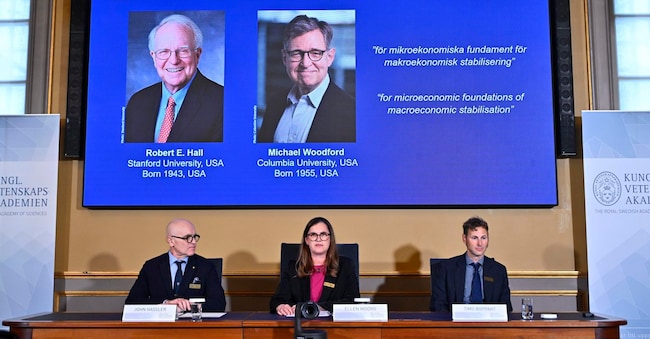
I membri del del Comitato per il Nobel annunciano il premio per gli economisti americani Robert E. Hall e Michael Woodford  EPA

3' min read

Translated by AI
Versione italiana

3' min read

Translated by AI
Versione italiana

The Nobel Prize in Economics for 2026 has been awarded to the Americans Robert E. Hall of Stanford University and Michael Woodford of Columbia University for ‘the microeconomic foundations of macroeconomic stabilisation’. The announcement comes from the Royal Swedish Academy of Sciences, which met in Stockholm for the final award ceremony of the current academic year.

“The winners’ work has provided us with a solid theoretical foundation for the models now used by central banks and governments around the world,” said John Hassler, Chair of the Committee for the Prize in Economic Sciences, adding that “thanks to these models, we are better equipped to deal with economic shocks, such as energy crises or sudden changes in household consumption”.

Loading...

Hall’s portrait

Robert E. Hall, aged 83, is something of a ‘seismograph’ for the US economy. An applied economist, leading academic and senior fellow emeritus at the Hoover Institution, Hall has spent the last forty years redefining the way in which governments and markets interpret economic cycles, consumption and taxation. Whenever an economic fluctuation in the United States is officially declared a ‘recession’, it bears his mark: for decades he chaired the prestigious Business Cycle Dating Committee of the National Bureau of Economic Research (NBER), the scientific body responsible for determining the start and end dates of US economic crises.

Woodford’s profile

Michael Woodford, aged 71, regarded as one of the founding fathers of modern monetary theory, has inextricably linked his name to the emergence of modern New Keynesian models (in particular DSGE models, or Dynamic Stochastic General Equilibrium). His research has revolutionised the way in which central banks analyse the economy, bridging the methodological gap between the microeconomic decisions of households and firms and the broad macroeconomic aggregates.

His 2003 treatise, Interest and Prices: Foundations of a Theory of Monetary Policy, has been the cornerstone of global monetary theory for over twenty years and is often compared in importance to the classic work by Milton Friedman.

The role of households and businesses in forecasts

The two Americans won this year’s Nobel Prize for demonstrating how economic models could be reworked to reinvigorate stabilisation policies. Instead of basing their models on statistical correlations between macroeconomic variables – such as inflation, output and consumption – they chose to ground them in microeconomic principles. This approach involves understanding how the aggregate actions of individual households and firms influence the economy as a whole. The economy, explains the committee that awarded the prize, is characterised by an alternation of phases of expansionandcontraction. Ever since, almost a century ago, the economist John Maynard Keynes formulated his theories, stabilisation policies have played a central role in countering these fluctuations.

When even Keynes ‘gets it wrong’

During recessions, the economy is stimulated by cutting interest rates and increasing the budget deficit , whilst the exact opposite must be done to cool down an overheating economy. However, during the oil crises of the 1970s, it became clear that Keynesian models – which determine the timing and methods of implementing policy measures – were no longer working. Instead of reducing unemployment, they triggered runaway inflation. The West experienced a decade characterised by low growth, high unemployment and high inflation. Many believed that stabilisation policies had done more harm than good and should be shelved.

A central element of the award-winning economists’ models is the assumption that households and firms act with a forward-looking perspective when making decisions regarding savings or price-setting. When governments and central banks communicate their economic policy plans, they can influence these future expectations and steer the economy in the right direction. Since their introduction, the new models have proved to be a valuable tool for managing the economic downturns that have affected us.

The prize in Economic Sciences, established in 1968 by Sveriges Riksbank, the Central Bank of Sweden, and awarded for the first time in 1969, is not formally one of the prizes established in the will of Alfred Nobel, but is awarded according to the same procedure and during Nobel Week. This year’s prize money totals 12 million Swedish kronor (approximately 1.06 million euros), regardless of whether the prize is awarded to a single individual, a small group of laureates or an organisation. Hall and Woodford will have to share it equally.

Copyright reserved ©
Loading...

Brand connect

Loading...

Newsletter

Notizie e approfondimenti sugli avvenimenti politici, economici e finanziari.

Iscriviti