
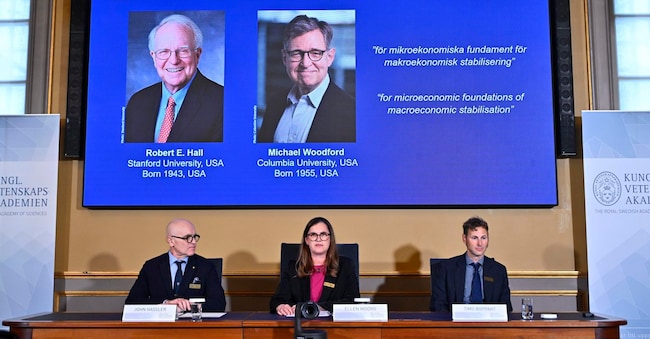
The 2026 Nobel Prize in Economics has been awarded to Robert E. Hall and Michael Woodford
The Royal Swedish Academy of Sciences has dedicated the prize to the ‘microeconomic foundations of macroeconomic stabilisation’

Key points
The Nobel Prize in Economics for 2026 has been awarded to the Americans Robert E. Hall of Stanford University and Michael Woodford of Columbia University for ‘the microeconomic foundations of macroeconomic stabilisation’. The announcement comes from the Royal Swedish Academy of Sciences, which met in Stockholm for the final award ceremony of the current academic year.
“The winners’ work has provided us with a solid theoretical foundation for the models now used by central banks and governments around the world,” said John Hassler, Chair of the Committee for the Prize in Economic Sciences, adding that “thanks to these models, we are better equipped to deal with economic shocks, such as energy crises or sudden changes in household consumption”.
Hall’s portrait
Robert E. Hall, aged 83, is something of a ‘seismograph’ for the US economy. An applied economist, leading academic and senior fellow emeritus at the Hoover Institution, Hall has spent the last forty years redefining the way in which governments and markets interpret economic cycles, consumption and taxation. Whenever an economic fluctuation in the United States is officially declared a ‘recession’, it bears his mark: for decades he chaired the prestigious Business Cycle Dating Committee of the National Bureau of Economic Research (NBER), the scientific body responsible for determining the start and end dates of US economic crises.
Woodford’s profile
Michael Woodford, aged 71, regarded as one of the founding fathers of modern monetary theory, has inextricably linked his name to the emergence of modern New Keynesian models (in particular DSGE models, or Dynamic Stochastic General Equilibrium). His research has revolutionised the way in which central banks analyse the economy, bridging the methodological gap between the microeconomic decisions of households and firms and the broad macroeconomic aggregates.
His 2003 treatise, Interest and Prices: Foundations of a Theory of Monetary Policy, has been the cornerstone of global monetary theory for over twenty years and is often compared in importance to the classic work by Milton Friedman.

