
Up and down Italy’s volcanoes, accompanied by literary reminiscences
On Mount Vesuvius with Leopardi, amongst the broom and Lacryma Christi

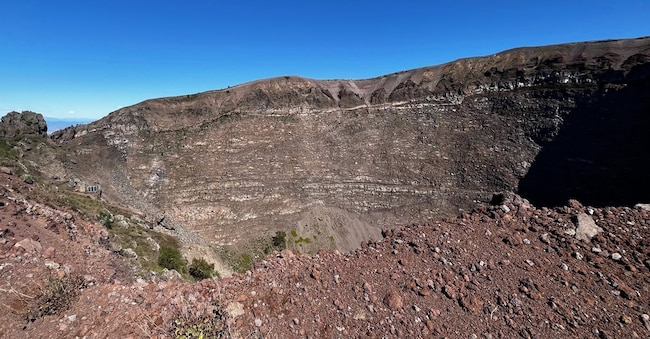
Johann Wolfgang Goethe managed to witness it during an eruption. He rode a donkey for a long stretch, accompanied by his trusted artist and draughtsman, and then had to continue on foot, yet he was not disappointed by the spectacle that met his eyes. Giacomo Leopardi, though limping and unsteady on his feet, could never resist its fatal attraction. Not least because, during the ascent, he could admire the poetic broom bushes. Within the National Park, Vesuvius can be conquered by walking along the marked trails in the Valle dell’Inferno, which starts from the historic centre of Ottaviano, climbing up the slopes of Monte Somma, which reaches a maximum height of 1,132 metres near Punta Nasone. Alternatively, having booked a ticket in advance on the National Park’s website, you can pass through the entrance leading to the Gran Cono, before tackling the few hairpin bends that lead to the rim of the crater, which can be walked around for most of its circumference: the view stretches across all the islands of the Gulf of Naples; in the panoramic bar, you can raise a glass of Lacryma Christi del Vesuvio DOC, the wine produced on the slopes of the volcano, accompanied by dishes featuring Piennolo cherry tomatoes, another delicacy from the soil surrounding the caldera. Pines and lichens adorn the chasm, which currently has a diameter of around 450 metres and an estimated depth of 300 metres, beneath which lies a tunnel extending from three to eight kilometres. The railway viaducts commissioned by the Cook travel agency and the architectural silhouette of the Vesuvian Observatory – the oldest scientific institution dedicated to the study of volcanic eruptions – arouse just as much curiosity. You can also take part in an expedition led by a volcanologist, organised by the Belmond Hotel Caruso in Ravello, designed to explore the geology and flora of Vesuvius.

