
Up and down Italy’s volcanoes, accompanied by literary reminiscences
The volcanic lakes of Vulture: from Frederick II to the brigands

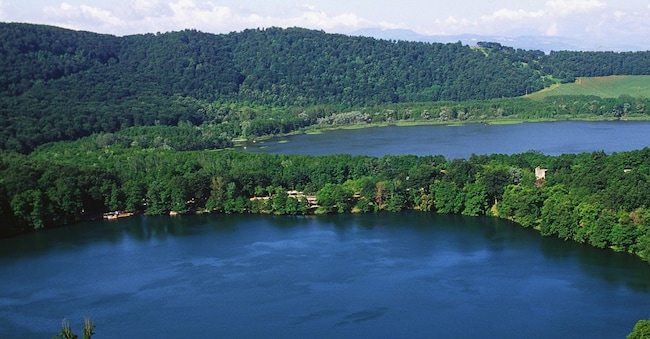
Above Lago Piccolo and Lago Grande, eagles continue to circle, as if seeking to ‘claim’ ownership of the Vulture craters. In the Monticchio area, between the municipalities of Atella and Rionero in Vulture, in the province of Potenza. The two craters are filled with the waters of Lake Vulture, not far from the town of Melfi, which also stands on a lava flow. Here, it is as if one were in the midst of a rugged mosaic of rocky outcrops culminating in Monte Pizzuto, 1,326 metres high, whose collapse caldera is identified precisely as the Monticchio Lakes, with the caldera rims recognisable in the two basins and the Piano Comune. All around, forests of chestnut, beech and oak envelop the landscape beneath a green canopy, creating a truly romantic scene. Water lilies bob gently on the lake’s surface. One can first visit the Benedictine Abbey of St Michael the Archangel, built in the 8th century near a cave carved into the tuff, later occupied by Capuchin friars who were fervently devoted to the study of sacred texts, whilst the present building dates from the 18th century. Giuseppe Ungaretti compared the peaks of the Vulture to ‘jagged teeth. Water, fire, eruptions and floods have left their mark on the surrounding boulders’. Roberto Guiscard and Frederick II of Swabia loved to hunt here, whilst today fossil enthusiasts come in search of prized specimens: the National Archaeological Museum of Melfi preserves precious artefacts from the peoples who once lived in the volcanic area, a place also chosen by bandits who took refuge in the Vulture until the early decades of the 20th century to go into hiding. A far more comfortable option is… staying at the Relais la Fattoria near Menfi.

