
A leisurely journey through Turkey in search of precious archaeological treasures
Priene and the other wonders of the Ionian coast

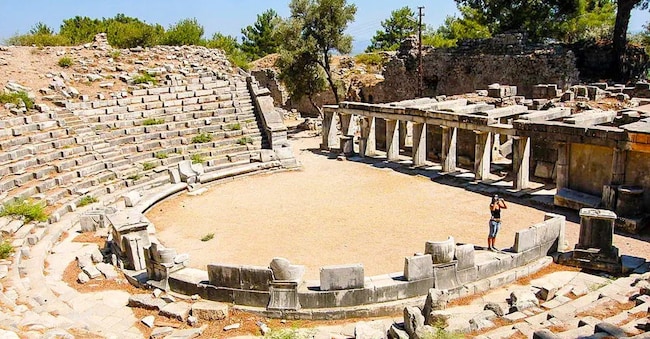
It clings to a hillside as if it were in danger of tumbling down at any moment. This very position helps to make Priene a truly captivating place amongst the former Greek colonies in Asia Minor. Its original settlement is thought to date back to the 4th century BC, but the Ionians had probably arrived several hundred years earlier, lending an air of prestige and splendour to the Panionian festivals held there. The decision to take part in the uprising against the Persians proved costly for Priene, which was destroyed, only to be rebuilt around 350 BC and subsequently annexed to the Roman provinces. You should explore this archaeological site at your leisure: in doing so, you will come across the house attributed to Alexander the Great, the fish and meat market, the agora with the Temple of Zeus, and the elegant stoa. Certainly, the quadrangular bouleuterion, with tiered seating on three sides, where the city council of 640 members (2nd century BC) used to meet – thanks to its excellent state of preservation – and the altar adorned with laurel leaves and bull’s heads, will remain etched in the memory for a long time. The same is true of the theatre of Priene, where not only actors but also political orators could take to the stage, as evidenced by the presence of an hourglass at the western end of the auditorium: this was used to time their speeches. The remains of the Temple of Athena are also striking: the foundations and part of the Ionic marble colonnade have survived. It seems certain, as suggested by an inscription on display at the British Museum in London, that Alexander the Great personally commissioned it. The statue of Athena, however, was a copy of the more famous one from the Parthenon.
There are three small archaeological sites linked to Apollo not far from Priene, all situated in the Menderes district. In particular, Claros, where the remains of the Sacred Way can still be seen; this led to the temple where worshippers and the most important authorities came to consult the oracle: there was a system of underground passages leading into the first chamber, where the sacred stone dedicated to Apollo was situated. The nearby site of Notion is also well worth a visit, thanks to the ruins of the ancient Ionian city scattered throughout the site, nestled amongst the local vegetation and situated on top of a hill overlooking the Aegean coast and the village of Ahmetbeyli: this is where the boats carrying pilgrims bound for Claros used to moor. It had imposing walls with a total circumference of four kilometres and housed a theatre and a temple dedicated to Athena. These sacred sites were mainly reached on horseback, setting out from Colophon, a rival town, whose archaeological site – perhaps due to a lack of restoration and conservation, and certainly because the excavations remain incomplete, although they have brought to light the thermal baths, the roads and some buildings dating back to the 6th century BC, is imbued with an authentic, wild atmosphere, where the wind reigns supreme.

