Autobiographical story

Showdown with father's corpse

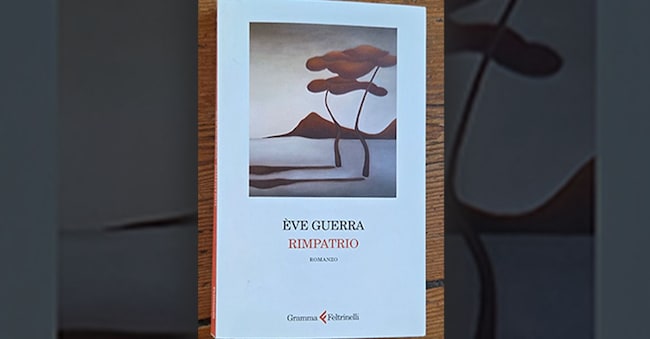
'Repatriation', by Ève Guerra, is the story of a daughter who tries to bring back to France the body of her father who died in Africa and is confronted with the memory of a violent man

by Lara Ricci

4' min read

Translated by AI
Versione italiana

4' min read

Translated by AI
Versione italiana

"He died that day there, when the light from the garden came through the glass door". On the afternoon she receives the news of her father's death, Annabella is 23 years old and is in the library studying for an Arts exam.

She descends the stairs, goes out into the cold spring light, spends the last of her money buying a card to phone her aunt and uncle. She listens to them scold her for disappearing, for not answering messages, she listens to them tell her that her father's body is in Cameroon and may not be able to be repatriated, that she must join them immediately on the other side of France.

Loading...

The credit ends and Annabella passes through Lyon in a state of muffled perception, where external events arrive sudden and muffled, unexpected and unexplained, sunk as she is in the memories she has held at bay for many years and which now assail her. Lost within herself, absent and at the same time finally present, with her 'body at the edge of her skin, almost naked'. Immersed in the flow of life.

I killed my father, she keeps telling herself as she wonders how to find the money to reach her aunt and uncle. She cannot ask her boyfriend, having told him that his father had died two years earlier, nor her friends, her university friends.

Lyon and the Rhone flow before her eyes, but she is in a forest in Congo 'where the light can no longer enter': she is nine years old when she first decides to leave, to leave her father. She is a snake among snakes, as a metamorphosed snake is the Congo river - a pygmy (this is the word used in the Italian translation, though derogatory) had told her, adding that it was a snake one should not be afraid of. A snake that slips away like life, and she of life - we understand this as the book unfolds - is instead very afraid.

On that day long ago, Annabella had decided to run away from a violent man, from the abandonment of her mother, a Congolese girl who had given birth to her when she was sixteen, who had left when the daughter was seven years old after being beaten up by her father.

And if the little girl's escape that day did not last long, it was different from the civil war that broke out a few months later. An escape along the country's most remote tracks in her father's pick-up truck, having failed to reach the capital in time, where Frenchmen, as her father was, were put on a flight and sent back to Paris. A descent into the hell of degradation.

In Repatriation, winner of the Goncourt Prize first work, French-Congolese writer Ève Guerra skilfully juxtaposes the events of the hallucinated present with those of a past clouded by pain, by the desire not to remember.

And so he plunges us into a dark Africa, that of the expats ('expatriates', migrants from rich countries) who drown in alcohol the violence of their privilege, their selfishness, their ill-concealed lusts. An Africa reminiscent of Esilio (2012, il Saggiatore) a bitter posthumous novel by Danish author Jakob Ejersbo, also the son of expats. An Africa where Annabella as a child, riding a bicycle, rushed down the hill without looking at the road: 'it seemed to me that the truths of the world penetrated my soul through my body'.

Modern Antigone, the protagonist of this intense and poetic autobiographical debut tries to reach her aunt and uncle and then remotely 'disembowel' her father's body from the bureaucracy and deceptions devised by the company that had hired him off the books and does not want to take responsibility for the machinery that crushed him. At the same time, she sinks into an inner journey, in search of a man she will never see again and whose image already escapes her, like that of her mother, like that of her grandmother.

A man she has never really known, unreachable in his cocoon of lies. Unreachable and painfully longed for, like the early childhood during which she believed and continues to believe she was happy. She thus finds herself face to face with an Annabella who is a stranger to her, and who would like to continue to be a stranger to her, seeing herself looking more and more like her father. Both with 'their eyes totally turned inwards, and away from the world'. Both on the run from themselves and their past.

'May you never know who you are', reads a sentence from the Edipus re of Sophocles in the book's exergue. A wish that again will not be fulfilled, but that will not be a bad thing: the body will somehow be brought home, and with it will come a new awareness.

 Repatriation, in fact, is the account of a long-avoided face-to-face, that of the protagonist with an illusion of happiness that wounds her every day, with a desperate need to love and be loved even when this is impossible. A love that, in order to survive, deviates from the object to the subject, annihilating itself. Repatriation is a reckoning with a father with many faces, an ambiguous father, also a child of violence. A father who, whether she loves him or rejects him, produces the same effect on Annabella: that of imprisoning her. A bitter and sincere reckoning with her own roots.

CONFIDENTIAL REPRODUCTION

Ève Guerra, Rimpatrio, translation by Anna D'Elia, Feltrinelli, pp. 192, euro 18

Copyright reserved ©
  • Lara Ricci

    Lara Riccivicecaposervizio curatrice delle pagine di letteratura e poesia

    Luogo: Milano e Ginevra

    Lingue parlate: Inglese e francese correntemente, tedesco scolastico

    Argomenti: Letteratura, poesia, scienza, diritti umani

    Premi: Voltolino, Piazzano, Laigueglia, Quasimodo

Loading...

Brand connect

Loading...

Newsletter

Notizie e approfondimenti sugli avvenimenti politici, economici e finanziari.

Iscriviti