

The Emirates are making great strides with Sharjah
Having demonstrated its capabilities in air defence, the UAE – even though the property sector continues to produce 4,000 new units a month – is channelling foreign funds into technology hubs. Thanks to Spark, Sharjah has already secured $2.5 billion in funding

Whilst the world debates new alliances and fears for the future of Hormuz and the Bab el-Mandeb Strait, the United Arab Emirates – having demonstrated its ability to manage a complex air defence system – is shifting into a new gear. Alternative routes, the triangulation of investments towards India and the Far East, and, finally, scope for new enterprises capable of accelerating the incubation of technology. And what stands out at the moment is the mobility and dynamism of Sharjah.
The central emirate of Sharjah
Around a 40-minute drive north of Dubai, the city – situated in the heart of the emirate, which until now has been known primarily for its cultural traditions – has been recording significant growth in foreign direct investment and new jobs for the past three years. Even in recent months, despite slowdowns caused by the war and drone attacks, the trend has continued. Last Thursday, a meeting on port operations was held. Over 7,000 participants, representing a large proportion of the rail logistics sector, to discuss land-based connections with the aim of bypassing Hormuz and developing routes from the UAE capable of reaching as far as Jordan and, if necessary, linking up with the infrastructure launched by Saudi Arabia and Turkey along the former route of the Ottoman Empire railway. ““Given the geopolitical situation,” said Ahmed Obaid Al Qaseer, CEO of the Sharjah Investment and Development Authority, speaking at the event , “we believe even more strongly in logistics development”, highlighting the port of Khorfakkan, which looks directly out onto the Indian Ocean.
Overall, Sharjah is shifting its position: from a cost-effective alternative to Dubai to a production and logistics hub with its own technological agenda. The three figures that best illustrate the current situation are the 45 per cent increase in projects funded directly by foreign capital, the approximately $15 billion in property transactions forecast for 2025, and the recent entry of Aldar into the city’s property market with an investment exceeding $1 billion. Within the UAE economy as a whole, the two variables to keep an eye on are the trajectory of investment in the second half of 2026 and the pace of delivery of new properties, given that the strong cycle of new launches could shift the balance between supply and demand.
Real estate figures
In early October, Emaar’s CEO, Mohammed Alabbar, stated that in 2025 the monthly supply of properties coming onto the market in the UAE stood at around 4,000 units, with around 600 contracts cancelled. Over the half-year, this figure rose to 1,200 and is now falling towards 1,000 units. Meanwhile, the occupancy rate stands at 60 per cent compared with last year’s figure. This is a sign that the war has affected the sector, though not as dramatically as in 2020, and that, conversely, the technology sector has absorbed the impact. This is particularly true in this small emirate (with a population of 2.2 million) which, according to figures provided earlier this month by the CEO of Invest in Sharjah Mohamed Al Musharrakh, is expected to reach a target of 2.5 billion dollars. This represents a 20 per cent increase compared with 2025, driven by logistics and transport, light manufacturing and technology.
Sharjah Research, Technology and Innovation Park
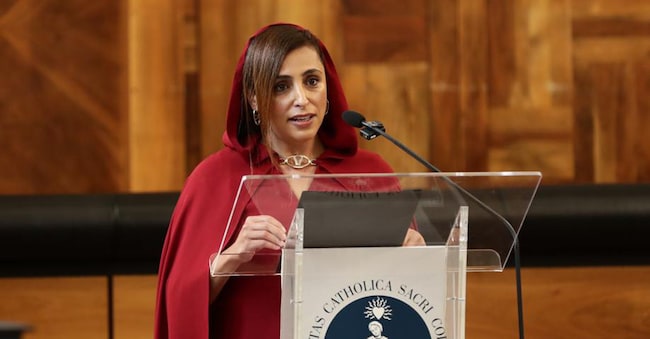
The cornerstone of this final pillar is known as Spark. Sharjah Research, Technology and Innovation Park is a free zone established in 2016 by decree of Sheikh Sultan bin Muhammad Al Qasimi, built on a ‘triple helix’ model that connects over 150 academic institutions, companies and start-ups. The pillars are sustainability and environmental technology, digitalisation (AI, big data, IoT), healthcare and advanced manufacturing. Spark is home to SoiLab, an open-access prototyping hub. The latest development for 2026 is the AI Hub, unveiled on 31 March: a one-stop shop for AI consultancy, applied research, data analytics, prototyping and advanced computing infrastructure, aligned with the UAE’s AI Strategy 2031. The CEO Hussain Al Mahmoudi has described it as a step towards establishing Sharjah as a global destination for advanced technologies. Finally, driving this initiative is a key figure: the chair of Spark and the Investment Authority Sheikha Bodour bint Sultan Al Qasimi. She began her career in 2007 by publishing children’s books with the aim of shaping the emirate’s cultural identity and bringing the series to the wider Middle East. She now holds several positions. In addition to the two mentioned above, she is president of the American University and devotes a significant part of her schedule to cultural diplomacy. A symbol of a Sharjah that few in Italia and Europe are familiar with.


