
In Wilhelmine Bayreuth, the German cradle of music
The ephemeral architecture of the Margravial Opera House
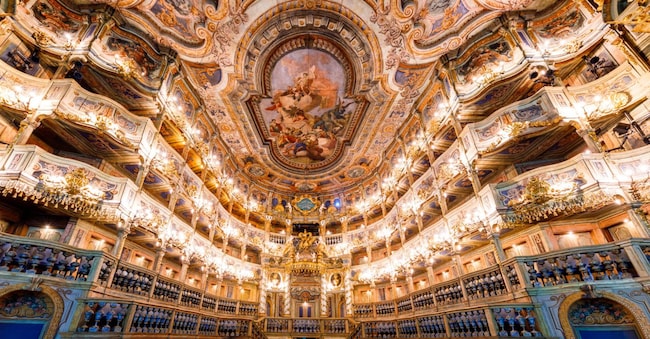
It represents the most eloquent and magnificent example of a Baroque court theatre still existing in the world. It was erected between 1744 and 1748, taking as its model the most significant opera houses of the time, such as those in Vienna and Dresden. It was precisely the direct connection between the Margravial Opera House and 18th century musical culture that led to this architectural 'alcove' of musical culture being inscribed on the UNESCO World Heritage list. Above all, the Italians Giuseppe and Carlo Galli Bibiena, who specialised in this type of building, were responsible for the design. They placed the Redoute Haus, the ballroom, at the heart of the building. Originally, with a depth of 27 metres and a width of 25, its stage was one of the largest in Europe. In addition, sophisticated machinery behind the scenes allowed for quick set changes and special effects. The stone façade was completed in 1750 by court architect Joseph Saint-Pierre. Immediately perceptible is the 'kinship' with the Italian lodge theatres of the time: the perfectly preserved tiers of seats were mainly made of wood and canvas, frescoes and paintings contribute to the sumptuousness of this masterpiece of ephemeral festive architecture in which numerous unmissable performances are staged today. Melomaniacs can also embark on the Walk of Wagner, a walk in stages that touches on the most significant places in the composer's life, starting with his villa, Haus Wahnfried, where he completed his opera The Twilight of the Gods. and the Angermann, the restaurant where he used to dine.

