
From Syracuse to Ragusa between archaeology, food and sea
The eternal enchantment of the classical theatre Inda in Syracuse

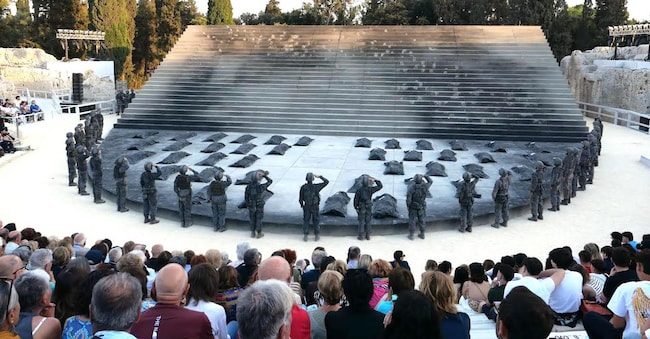
The programme of classical plays at the Greek Theatre in Syracuse staged by the National Institute of Ancient Drama includes Aeschylus' The Persians and the Iliad from Homer's magmatic poem. For fans who come to watch these exciting plays, it is a summer ritual that repeats itself: spectators cross the threshold of the Neapolis Archaeological Park, one of the five that made up Syracuse in the Greek and Roman periods, just before sunset. Perhaps they have just finished a visit to the Roman Amphitheatre, the Altar of Hieron II, the grandiose altar used for public sacrifices, the Via dei Sepolcri, with its Hellenistic layout and set in the rock, and were enchanted - after enjoying an almond granita in the Momento botanical café nestled among the remains - by the magnificent arch of the Latomie del Paradiso and Santa Venera, the ancient stone quarries, as well as the Grotta dei Cordari and the Ear of Dionysus. Otherwise, they can choose, while waiting for the cathartic moment for lovers of Greek tragedy to enter the semicircular cavea with 67 tiers of steps originally intended to accommodate popular assemblies - the sets and interpretations, as well as the costumes and lighting are very contemporary - to follow the itinerary inside the Apostolic Palace of Ortigia. Thus they discover the Swabian Chapel with its splendid cross-vaulted ceiling, the silver altars and monstrances decorated with precious stones in the Diocesan Museum, and above all the 17th-century Biblioteca Alagoniana, a walnut casket containing 70,000 ancient manuscripts. A stone's throw away, on the tip of Ortigia, you can visit the Frederician Maniace Castle, overlooking the cliffs and lighthouses of the precious Protected Marine Area Plemmirio. And a little further on, you can take a swim near Fort Vigliena, along the perimeter of the walls that protect the Baroque palaces against the stormy seas, next to the Cathedral of the Nativity of the Blessed Virgin Mary built on the ruins of the Greek temple of Athena, whose columns date back to the fifth century B.C. while the façade is 18th-century. In the meantime, however, a muscular Apollo whose body shines in the light of the setting sun has appeared on the vertical staircase mounted on the theatre stage: the magic of ancient yet modern representations can begin.

