

The Greek renaissance. With US backing, Athens becomes the EU’s eastern border
The agreements concluded by Secretary of State Marco Rubio and Prime Minister Kyriakos Mitsotakis cover energy, defence, logistics, cyber security and space. Above all, however, they redefine a corridor stretching from Piraeus through Ukraine to Poland. It paves the way for the reconstruction of Kyiv and the scaling back of German influence in the north and Turkish influence in the south.

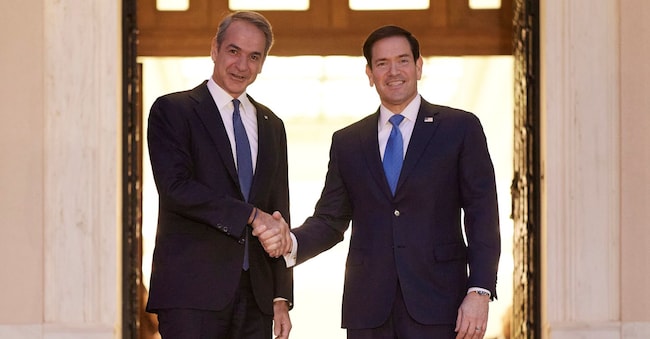
The US Secretary of State, Marco Rubio, has left Athens following a busy day of meetings as part of the Greece-US Strategic Dialogue. Among others, he met with the Foreign Minister, Giorgios Gerapetritis, and the Prime Minister, Kyriakos Mitsotakis. Announcements, statements and street protests. But now, with the dust settled, it is worth analysing the political shift taking place behind the scenes. It is clear that Washington has chosen Athens as its primary partner in the eastern Mediterranean. This applies to various geopolitical areas. The first concerns energy. Not only, as many have written, to add Greece to the ranks of buyers of American LNG, but also to ensure the continuity of a South-North corridor driven precisely by the US. Apart from the fact that Greek reserves can stabilise a section of Europe and that the country is home to two major regasification plants, Athens would provide the infrastructure that leads directly to Ukraine. Suffice it to say that Exxon and Chevron have asked the Greeks for authorisation to drill in a stretch of sea that Turkey and Libya have claimed at the UN, in the context of disputes relating to the UNCLOS treaties. The political setback for Ankara is clear and should not be underestimated.
As well as energy, logistics
Then there is a second aspect, perhaps more long-term in nature. This concerns rare earths, of which Greece has moderate reserves. US companies are committed to setting up joint ventures with Greek firms. And this is a sector that is vital for Italia too. Port and logistics agreements are the third aspect to analyse. Clearly, this is an American attempt to counterbalance the Chinese presence in Piraeus, but also to link the energy corridor with a parallel railway line which, in this case too, is aimed at Kyiv. It should be noted that military supplies are often slowed down by having to pass through Turkey. The fourth aspect is the best known and concerns military agreements. The US will expand its presence on the ground, particularly in Crete. This will partly replace the activities once planned for Germany. In addition, statements regarding the F-35 fighter jets appear aimed at demonstrating that the Shield of Achilles model – the result of recent agreements between Israel and Greece – can be partially integrated. Effectively extending the air defence bubble as far as Cyprus.
Cyber and Space
Rubio’s remarks also touched on the subject of data centres, as well as cyber and space cooperation. Greece does not have its own agency, but has nevertheless launched satellite projects, in one case under the Italian flag, given its partnership with Sitael.
The Future of NATO
On the whole, the chapters analysed – albeit in an extremely concise manner – paint a very clear picture. Europe’s eastern border, and thus its ability to attract investment, appears as a line that starts in Greece, runs northwards through Ukraine and ends in Poland. One cannot fail to notice the exclusion of Germany, which, in American eyes, is no longer a focal point of interest. It will be interesting to see whether and how the flows for the reconstruction of Ukraine will follow this trajectory. For Rome, there may be significant synergies and, in any case, a role that – as is often hoped – is directed towards the South. Thus, whilst there is open conflict over the future of NATO and American disengagement from the Alliance, we are witnessing the creation of building blocks that seem to be heading in a different direction.Greece and Cyprus have been moving briskly and quietly in recent years. The former by stepping up defence investment and concluding bilateral agreements that fall outside the European framework. The latter has been cultivating personal relationships with major Silicon Valley companies. We are probably witnessing a realignment of NATO activities, which can no longer be separated from energy, logistical security and investments within the framework of so-called friend-shoring.

