
The invisible bubble that protects us from the Sun. SMILE set off on a Vega C to photograph it
At dawn on 19 May, the Italia launcher put into orbit the Sino-European satellite for an unprecedented study of the Earth's magnetosphere. Avio managed the launch autonomously for the first time

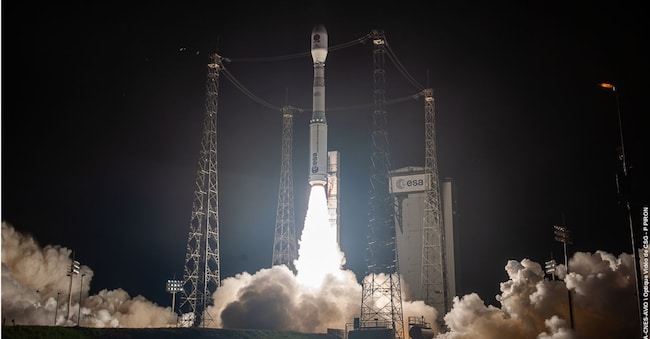
Kourou, French Guiana - It was 5.52 a.m. this morning, 19 May, in Italia, when a Vega-C rocket left its ramp with SMILE on board from the European Space Centre in Kourou.
An acronym for Solar wind Magnetosphere Ionosphere Link Explorer, it is a two-tonne scientific satellite developed by the European Space Agency (Esa) together with the Chinese Academy of Sciences (Cas). It will study space weather as never before, in particular the interaction between the Earth's magnetosphere, the magnetic bubble that surrounds and protects us, and the solar wind, the charged particles emitted by the Sun.
In addition to new knowledge, SMILE promises concrete applications: the Earth is constantly bombarded by the solar wind, i.e. by streams of charged particles emitted by our star. When the streams collide with the magnetosphere, phenomena such as geomagnetic storms, northern lights, disruptions in navigation systems and satellite communications, or overloading of power grids are triggered. Studying their dynamics interests science as much as telecommunications, defence and the security of critical infrastructures.

