

The Italian Institutions Building in Tangier celebrates its 100th anniversary
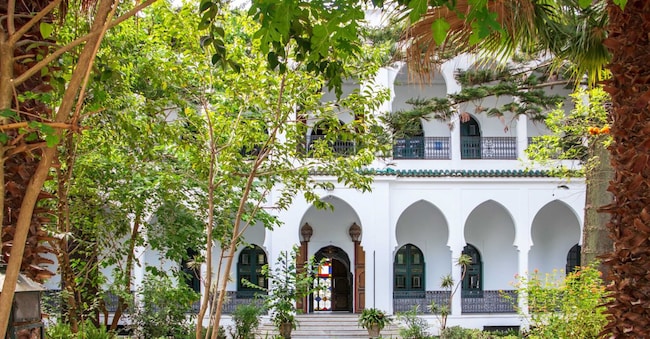
The residence, built in the early 20th century for Sultan Moulay Hafid, has over time become one of the most intriguing examples of the Italian presence in the city on the Strait. Today it hosts exhibitions and is preparing to mark the anniversary with a photographic book by Massimo Listi. Ambassador Salzano: ‘The building tells the story of a relationship built on culture, social interaction and people moving from one side of the Mediterranean to the other.’
by 24Ore NextMed
 Aggiungi Il Sole 24 Ore
ai preferiti su Google
Key points
There is a corner of Tangier where Italia has left its mark in the form of marble, stucco and colourful mosaics. It is the Palazzo delle Istituzioni italiane, a huge complex built in the early 20th century for the sultan Moulay Hafid and which, over time, has become one of the most intriguing examples of the Italian presence in the city on the Strait. Today, a new photography book by Massimo Listri brings it back into the spotlight. The book was previewed at the Musée Yves Saint Laurent in Marrakesh, during the sixth edition of the Rencontres de la Photographie: this year, Italia is the guest of honour. The initiative is being promoted by the Italian Embassy in Rabat and the Italian Cultural Institute. The aim is not so much to celebrate a monument as to rediscover a place where Moroccan history, the European presence and the memory of Mediterranean exchanges have built upon one another.
Thirty thousand square metres
You only need to look at the size to realise what we’re talking about: over 30,000 square metres, with grand halls, courtyards, marble columns, stucco decorations, carved woodwork, zellige mosaics and gardens. Within the complex there is also a church, a former Italian hospital and the buildings which for decades housed the Italian schools in Tangier. Until 1987, these schools educated generations of Italian and Moroccan pupils: a detail that shows how the palace was never merely a representative headquarters.
‘Part of our shared history’
The Italian Ambassador to Morocco, Pasquale Salzano, commented on this, describing the building as ‘not only a testament to Moroccan architecture, but also part of the shared history between the two countries’. According to the diplomat, the complex deserves to be much better known in Italia too: it tells a story woven from culture, education, social life and people moving from one side of the Mediterranean to the other. Tangier, after all, is the perfect setting for such a story. An international city by nature, a crossroads between the Mediterranean and the Atlantic, Europe and Africa, it has long been a place where communities, languages and trade networks have coexisted. The Palazzo delle Istituzioni Italiane fits perfectly into this cosmopolitan tradition, whilst retaining a strong Moroccan architectural identity. And today it has found a new lease of life: its halls and gardens host exhibitions, concerts and cultural events. It is therefore not a place frozen in diplomatic or colonial memory, but a contemporary cultural platform.
Listri’s perspective and the December event
This is where the work of Massimo Listri comes into its own – a photographer renowned for his images of monumental interiors, palaces, libraries and historic architecture. His photographs capture not only the grandeur of the complex, but also the details, materials and layers that tell its story. Following Marrakech, the official launch of the book is scheduled for December in Tangier itself, to mark the centenary of the complex’s history as the seat of Italian institutions in the city. An opportunity to reinterpret the building not as an isolated relic, but as a testament to a century of cultural relations between Italia and Morocco.

