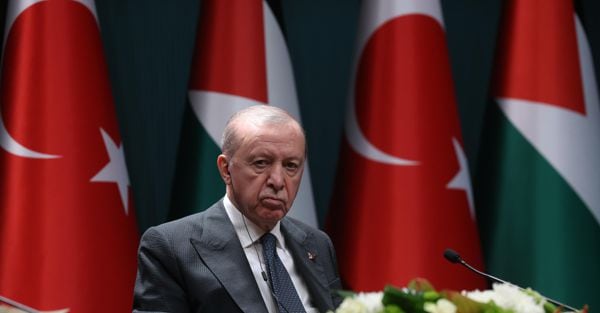
A map of the risks Iran poses to European countries. And Erdogan’s double trigger
Setting aside the alarmist tone of the Financial Times, from the Black Sea to Cyprus, from Akrotiri to Hormuz, the distinction between the front line and the rear has vanished. A new American attack would draw bases on EU territory even more deeply into the conflict, necessitating measures to counter hybrid warfare. And Turkey’s position – with its NATO and Middle Eastern agreements (and as a target of Israel) – makes the invocation of Article 4 of the North Atlantic Treaty more likely.

Key points
Setting aside the alarmist reports in the Financial Times regarding US bases in Europe, the question that should be occupying Palazzo Chigi, the Élysée Palace, Downing Street and the German Chancellery today is not whether Iran has decided to ‘attack NATO’. There is no evidence of such a decision in the available government sources. The issue is more serious: to what extent is Europe’s military, energy and logistical apparatus now geared towards a crisis that originated in the Gulf but is no longer confined to the Gulf? By 2026, the distinction between the front line and the rear had become blurred. Cyprus had been reached. Bulgaria has become part of the American logistical hinterland. Hormuz has become a European economic variable. And NATO, in Ankara, has begun to treat all these phenomena as components of a single strategic problem.
The most significant – and perhaps the least understood – event took place far from Brussels. On 2 March 2026, the British Prime Minister Keir Starmer informed the House of Commons that an Iranian drone had struck the RAF Akrotiri area, within the British Sovereign Base Area in Cyprus, crashing just a few dozen metres from British personnel without causing any casualties. On 9 March, the then Defence Secretary John Healey explained to Parliament that London had strengthened its regional defences and authorised the use of RAF Fairford and Diego Garcia by the United States for specific defensive operations related to Iran. In short, it is sufficient for bases, tankers, ports, command networks and energy infrastructure located on the continent to become necessary for supporting American or allied operations. At that point, the issue is no longer merely where the target is located, but what function it serves.
Bulgaria: the rear route becomes operational
Bulgaria is another sensitive case because there is no legal ambiguity here as there is in Cyprus: Sofia is a member of NATO. On 24 July 2026, the Bulgarian Defence Minister Dimitar Stoyanov travelled to Bezmer whilst refuelling operations and the organisation of the deployment of US air-to-air refuelling aircraft were under discussion. The Bulgarian government’s position was clear: Bulgaria does not consider itself a party to the conflict. Yet it is precisely this discrepancy between political interpretation and military function that poses a strategic risk. A base can therefore be politically ‘non-belligerent’ whilst simultaneously playing a vital role in the US operational chain. Based on the available primary sources, there is no evidence that Iran has ordered an attack on Bezmer. And it would be irresponsible to claim otherwise. But it is equally wrong to ignore the issue: if the conflict were to intensify, the distinction between those who fight and those who make fighting possible could become one of the central tenets of Iranian strategy. This is precisely where Europe must look closely: not at Tehran’s loudest rhetoric, but at the signs that precede a change in doctrine — targeted reconnaissance, cyber attacks on logistics networks, interest in fuel depots, tracking of tankers, surveillance of bases, and the public designation of host states as ‘participants’ in the conflict. Although of a different nature, the maritime drone intercepted in Romania is a clear indication of this hybrid warfare model.
London, the major exhibition
Of the major European powers, the United Kingdom is the one most directly exposed in operational terms. The British Strategic Defence Review regards the bases at Akrotiri and Dhekelia as strategically essential infrastructure and links the British presence in the eastern Mediterranean to the ability to operate in the Gulf. London combines elements that France, Germany and Italia possess only in part: territorial sovereignty over bases in the eastern Mediterranean, a presence in the Gulf, expeditionary capabilities, nuclear deterrence and exceptionally deep military integration with Washington. This strength is, at the same time, a vulnerability. The more the United States utilises British infrastructure to underpin its regional posture, the more London becomes the principal European bridge between NATO and the Middle Eastern theatre. The risk for Britain is therefore not merely that of suffering another drone attack. It is that of having to decide, within a matter of hours, whether an attack on its own infrastructure constitutes a limited incident to be absorbed, a violation of sovereignty to be dealt with autonomously, or the start of a crisis to be brought before the North Atlantic Council. The difference between these three responses could determine the entire trajectory of the escalation.
France and Germany: the political heart of the E3
France occupies a distinct position. Paris is not Europe’s main logistical hub for the crisis, but it is a nuclear power, a permanent member of the Security Council and part of the E3 alongside Germany and the United Kingdom. On 28 August 2025, the three countries activated the ‘snapback’ mechanism relating to international sanctions against Iran. From that moment on, for Tehran, the relationship with Paris has no longer been solely about the nuclear dialogue: it concerns sanctions, international legitimacy, economic access and Europe’s ability to maintain a common position. For this reason, France is probably more exposed to political, diplomatic, intelligence and cyber pressure than to a direct kinetic attack. Striking mainland France would offer Tehran very little advantage and entail an enormous risk; driving a wedge between Paris and Washington, London or Berlin would be far more useful. Germany, on the other hand, represents the point where security and economic power converge. Chancellor Friedrich Merz, on 17 April 2026, stated that Berlin was willing, once hostilities had ceased and provided there was a solid legal basis, to contribute to an international mission for the security of the Strait of Hormuz, citing mine clearance and maritime reconnaissance among the possible roles for the Bundeswehr.