Stockholm

The Nobel Prize in economics to Joel Mokyr, Philippe Aghion and Peter Howitt

The coveted award was made official today in Stockholm by the Nobel Committee for Economics composed of members of the Royal Swedish Academy of Sciences
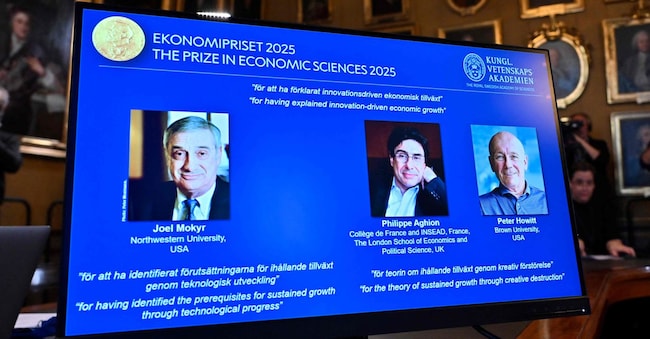
Uno schermo mostra i ritratti dei vincitori del premio 2025 (da sinistra) Joel Mokyr, Philippe Aghion e Peter Howitt, durante l'annuncio dei vincitori del Premio Nobel per l'Economia 2025, il Premio Sveriges Riksbank per le Scienze Economiche in memoria di Alfred Nobel, presso l'Accademia Reale Svedese delle Scienze a Stoccolma, Svezia, il 13 ottobre 2025. Il premio Nobel per l'economia è stato assegnato all'americano-israeliano Joel Mokyr, al francese Philippe Aghion e al canadese Peter Howitt per il lavoro sull'impatto della tecnologia sulla crescita economica sostenuta. (Foto di Anders WIKLUND / TT NEWS AGENCY / AFP) / Svezia OUT

3' min read

Translated by AI
Versione italiana

3' min read

Translated by AI
Versione italiana

The Nobel Prize in Economics 2025, dedicated this year to "creation and destruction", was awarded to Frenchman Philippe Aghion, Canadian Peter Howitt and US-Israeli economist Joel Mokyr,"for explaining innovation-driven economic growth."

The award goes half to Joel Mokyr of Northwestern University in Evanston, Illinois "for identifying the prerequisites for sustainable growth through technological progress" and half jointly to Philippe Aghion (College de France and Insead in Paris and London School of Economics and Political Science) and Peter Howitt (Brown University in Providence, Rhode Island) "for the theory of sustainable growth through creative destruction".

Loading...

The awarding of the coveted prize - which closes the annual season after the five that took place last week - was made official today in Stockholm by the Nobel Committee for Economics composed of members of the Royal Swedish Academy of Sciences. The Nobel Committee for Economics, which is composed of members of the Royal Swedish Academy of Sciences, was also the final committee of the Nobel Committee for Economics

In the last two centuries, for the first time in history, the world has witnessed sustained economic growth. This has lifted huge numbers of people out of poverty and laid the foundations for our prosperity," the Academy writes in announcing the award. "This year's Nobel Prize winners in economics, Joel Mokyr, Philippe Aghion and Peter Howitt, explain how innovation gives impetus to further progress.

Mokyr, in particular, 'used historical sources as a means of discovering the causes of the sustained growth that has become the new normal': 'He showed that, for innovations to follow one another in a process of self-generation, it is not only necessary to know that something works, but it is also necessary to have scientific explanations as to why. The latter was often lacking before the industrial revolution, which made it difficult to develop new discoveries and inventions. He also emphasised the importance of society being open to new ideas and allowing for change'.

Philippe Aghion and Peter Howitt have also studied the mechanisms behind sustained growth, the Academy explains. In a 1992 article, "they constructed a mathematical model for what is called creative destruction: when a new and better product enters the market, companies selling older products lose ground. Innovation represents something new and is therefore creative. However, it is also destructive, as the company whose technology becomes obsolete is overtaken by competitors". In different ways, the winners "show how creative destruction creates conflicts that must be managed constructively. Otherwise, innovation will be blocked by established companies and interest groups that risk being put at a disadvantage".

"The work of the winners shows that economic growth cannot be taken for granted. We must support the mechanisms behind creative destruction so that we do not fall back into stagnation," said Economics Prize Committee Chairman John Hassler.

The 2024 laureates

Last year's Economics Prize went to three economists - Daron Acemoglu, Simon Johnson and James A. Robinson - who studied why some countries are rich and others poor and documented the fact that freer and more open societies are more likely to prosper.

The Nobel Prize in economics, established in 1968, is officially known as the Bank of Sweden Prize for Economic Sciences in memory of Alfred Nobel, the 19th-century Swedish businessman and chemist who invented dynamite and established the original five Nobel Prizes in the categories of medicine, physics, chemistry, literature and peace. Since its inception it has been awarded 56 times to a total of 96 winners, of which only three were women.

 Nobel purists point out that the economics prize is not technically a Nobel Prize, but is always awarded together with the other Nobel Prizes on 10 December. As of 2017, the sum awarded to Nobel Prize winners amounts to 869,000 euros. The prizes are still financed by the interest earned on the capital donated by Alfred Nobel at the beginning of the 20th century.

Copyright reserved ©

Brand connect

Loading...

Newsletter

Notizie e approfondimenti sugli avvenimenti politici, economici e finanziari.

Iscriviti