Alternative routes

The Turkish-Saudi Hejaz Railway is reminiscent of the Ottoman Empire, but it is intended for the post-Hormuz era

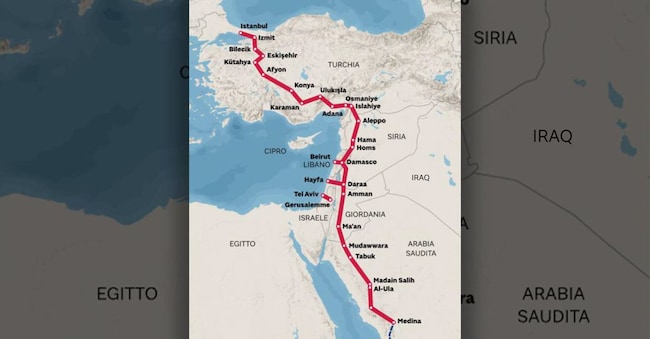
Two agreements have been signed to relaunch the route linking Istanbul, Saudi Arabia, Jordan and Syria, with possible branches to Lebanon and, in future, on to Oman, reaching the Indian Ocean. The aim: to create a strategic trade corridor along the railway lines originally designed to exercise control within the empire. Two regional giants, following the NATO-style military agreement, are joining forces for economic reasons.

 Una foto fornita dall'ufficio stampa della Presidenza turca mostra il presidente Recep Tayyip Erdogan (a destra) e il principe ereditario saudita Mohammed bin Salman (a sinistra). (EPA)

6' min read

Translated by AI
Versione italiana

6' min read

Translated by AI
Versione italiana

The efforts by the Gulf monarchies, Turkey and Europe to create alternative routes to Hormuz for goods, energy and data flows demonstrate how power has developed along value chains and how we have now entered the era of ‘node-based’ geopolitics. This is the logistics of the near future. That is to say, the points where data, maritime routes and sensitive infrastructure intersect. In this context, Italia and its industrial sector have the opportunity to transform their geographical position into infrastructural power, positioning themselves as a European hub for goods, energy, data and industry. However, the revival of the Hejaz Railway, and of the alternative trade corridor to Hormuz, must be viewed within a broader context. We are facing global structural changes, in which the Hejaz project represents only one part of the shifting global geopolitical landscape. Specifically, with regard to the Middle East, it reflects the aim of no longer being merely a player in the energy sector focused on the extraction and refining of crude oil, but of establishing a role in marketing as well, whilst maximising and diversifying their economies.

Roots in history

Its construction in the early 20th century was commissioned by the Ottoman Sultan Abdulhamid II. Stretching some 1,300 km, it linked Damascus to Medina, passing through Jordan. It was built between 1900 and 1908 to facilitate the pilgrimage and, above all, to strengthen political control over the area. It was largely funded by donations from Muslims around the world and by funds from the Ottoman Empire. It suffered severe damage during the First World War, during the Arab Revolt against Ottoman rule. Along the old route there are stone stations, disused bridges and, in Medina, a museum. Some sections of the line were destroyed during the war, mainly in the south, whilst sections of the line in the north continued to operate intermittently until 1925, when it ceased operations altogether.

Loading...

The agreement to revitalise the Hejaz

On 9 June, during a state visit by the Turkish Minister of Transport and Infrastructure, Abdulkadir Uraloglu, and the Saudi Minister of Transport and Logistics, Saleh bin Nasser Al-Jasser, two Memoranda of Understanding (MoUs) on railways and logistics were signed in Riyadh to revive the historic Hejaz Railway. However, this is not merely a historical restoration, but rather the creation of a strategic transport link between Anatolia, the Levant, the Arabian Peninsula and, at a later stage, the Indian Ocean. Meanwhile, on 7 April, another MoU was signed between Turkey, Syria and Jordan as part of their plans to revitalise the Hejaz Corridor, by building the missing infrastructure in Syria and upgrading existing infrastructure in Jordan. To lend a further degree of credibility to the intentions to proceed with the trade corridor project – viewing it merely as a simple railway project does not account for its strategic scope – on 7 August, Saudi Arabia, Turkey and Pakistan signed a trilateral defence agreement, the Makkah Joint Defence Agreement. Under this agreement, an armed attack against any one of the three countries will be regarded as an attack against all three. The strategic importance of this pact lies in the complementary nature of the three actors: Saudi Arabia’s economic clout, Turkey’s robust military-industrial complex and Pakistan’s nuclear deterrent.

IL PROGETTO DELLA NUOVA FERROVIA HEJAZ

Loading...

The new infrastructure

We are witnessing the emergence of a new geopolitical order defined by competition to secure economic corridors, markets and transport routes for goods and energy. The current situation is the result of a new context and the end of globalisation as we have known it until now. As regards the Hejaz Railway, why is this project only being revived now, after more than a century? There are many reasons. For Saudi Arabia, this represents an opportunity to position itself as a hub and logistics centre between the Gulf States, the Mediterranean and Europe – the crossroads for three continents. Under the Assad regime in Syria, there was no political will to enter into such an agreement with Saudi Arabia. The same remains true, even today, for Iran. Turkey, on the other hand, had previously been aiming for EU membership; consequently, it had no incentive or reason to want to revive a railway linking it to Saudi Arabia. Today, however, Turkey – like any other country of its size and economic standing – is seeking opportunities and an influx of investment. As for Syria, following the fall of the regime and nearly 14 years of civil war, it must rebuild the country, and the revival of the railway line represents a major opportunity. Jordan also has an interest in the revival of the railway, as it plays no significant role in the global economy apart from its phosphate exports. For Europe too, this geopolitical development offers opportunities, creating an alternative route to natural gas from the United States, the Middle East and Azerbaijan, and protecting it from a Russian gas monopoly once sanctions are lifted. However, these geopolitical and economic developments are perceived as a threat by some countries. Iran views the agreements unfavourably because they reduce its clout and influence in the energy market, and it is not in favour of the emergence of an economically prosperous Syria. If the corridor were to become a reality, bringing prosperity, it would also weaken Iran’s influence in Iraq. For Russia, the creation of alternative energy transport corridors in the future poses a threat. Even in the event of a resolution to the war in Ukraine, the subsequent lifting of sanctions, and the reconstruction of Russia’s energy sector infrastructure, the Hejaz Corridor offers a viable alternative for Europe’s energy supply. For Israel too, which is excluded from the agreement, its possible implementation is not considered to be in the country’s interests.

Benefits for Italy

For the Italian industrial sector, one opportunity lies in the creation of a logistics corridor. This would involve the creation of an alternative regional network for the transport of goods and passengers. On 17 June 2026, a Memorandum of Understanding (MoU) was signed between Ferrovie dello Stato and the Saudi Railway Company. This agreement covers infrastructure, safety, maintenance, sustainability and consultancy services for public and private investors in the MENA region. This agreement forms part of a broader institutional dialogue between Italia and Saudi Arabia. The agreement provides for the possibility of developing a regional hub in Saudi Arabia for railway testing, such as static and dynamic tests, validation of new-generation rolling stock, signalling and control systems, resilience and operational safety. Furthermore, this memorandum could serve as a gateway for Italia to the entire railway sector in the MENA region, without having to wait for the Hejaz railway initiative to be implemented.

The emergence of new trade alliances

New trade blocs and alliances are taking shape, reshaping the economic landscape more rapidly than formal alliances. The revival of the Hejaz railway line could have been achieved earlier, as far back as the 1970s, but those were the years of the Cold War and the balance of power was different. It is happening now because the balance of power has shifted. China, with its Belt & Road Initiative (B&RI) launched in 2013 to build a bridge between China and Eurasia, aims to achieve supremacy in Asia. The United States and Italia, through the Lobito Corridor, launched under Joe Biden’s presidency, are aiming to create a railway and corridor capable of linking the Atlantic Ocean to the Indian Ocean, thereby facilitating the export of highly strategic raw materials such as copper and cobalt. The India–Middle East–Europe Economic Corridor (IMEC, 2023), a project aimed at establishing an India–Middle East–Europe economic corridor to boost trade, energy and digital exchanges between the economies involved; the Iraqi Development Road (2024), whose signatories are Iraq, Turkey, Qatar and the United Arab Emirates, aims to link the major port of Al-Faw – set to become one of the ten largest in the world – with Faysh Khabur on the Turkish-Iraqi border, thereby strengthening ties between Iraq and the Gulf states; the CPEC/Gwadar (launched in 2015) to establish a joint economic corridor and turn the port of Gwadar into a regional connectivity hub – one of the cornerstone projects of China’s New Silk Road, strengthening the axis between China and Pakistan; the China–Europe Railway Express and the EU corridors known as TEN-T. All these initiatives were launched before the Hormuz crisis, indicating the shift that is currently taking place.

Copyright reserved ©
Loading...

Brand connect

Loading...

Newsletter

Notizie e approfondimenti sugli avvenimenti politici, economici e finanziari.

Iscriviti