

‘The Western Mediterranean Euroregion: revitalising Sardinia’
Following the example of the Baltic and the Adriatic-Ionian regions, “Medoc could develop broader relations with the coastal regions of the Maghreb”, explains Salvatore Cherchi, vice-president of Isprom

“It is necessary to reaffirm the objective of establishing the Western Mediterranean Euroregion (Medoc),” stresses Salvatore Cherchi, vice-president of Isprom as well as the creator and promoter of the Sar-Med Annual Report, “drawing on the positive experience of Euroregions that have been operational for some time, such as those in the Baltic and the Adriatic-Ionian regions. Medoc could develop broader relations with the coastal regions of the Maghreb’. This point was highlighted during the presentation of the fourth Sar-Med Annual Report, Sardinia-Mediterranean, produced by the Institute of Studies and Programmes for the Mediterranean (Isprom), in collaboration with the Universities of Cagliari and Sassari.
The starting point for this work, edited by Marco Calaresu, Michela Cordeddu, Patrizia Manduchi, Francesco Nuvoli, Giovanni Sistu and Stefano Usai – the latter also serving as the project’s scientific director – is the situation in the Mediterranean basin and the international changes affecting Sardinia due to its ‘central’ position.
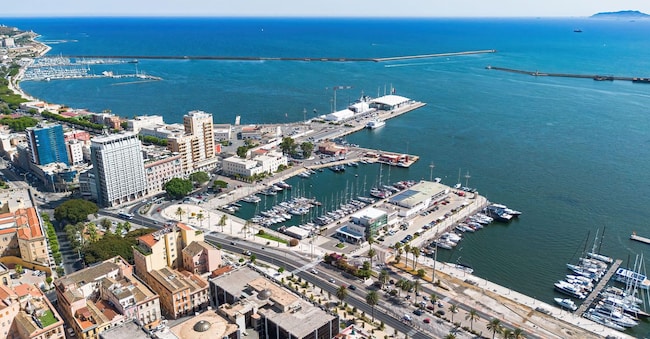
This includes another issue affecting the Mediterranean and Sardinia: resources. Foremost among these is water, which ‘has become the critical factor for energy, agriculture and industry’. It is no coincidence that the report analyses the role of water as a strategic resource ‘in the light of climate change and assesses the progress and limitations of European policies on water resilience’. In this context, the pressures associated with the establishment of new energy-intensive and water-demanding facilities driven by the digital and energy transitions – such as data centres for artificial intelligence and green hydrogen production plants – take on new significance. For this reason, the study highlights the need for rigorous territorial governance, capable of preventing conflicts over the use of local resources and of integrating these developments into a coherent regional planning framework. Equally important is the issue of transport and logistics, with Sardinia serving as a maritime and port hub along the route to North Africa.
“The issues addressed in the Report highlight matters of crucial importance for Sardinia’s future and confirm how cooperation with Mediterranean countries can help to strengthen the island’s economic and social system,” commented Giacomo Spissu, president of the Fondazione di Sardegna. “The energy issue, which is increasingly linked to the international balance of power, requires decisions capable of supporting the transition and promoting greater diversification of production. On the demographic front, the progressive ageing of the population and the loss of skilled young people make it necessary to create the conditions to guarantee employment opportunities and the right to remain. In this context, education plays a central role, both in reducing inequalities linked to one’s background and in building, through training and research, new relationships between Mediterranean communities.”
With regard to coastal protection, the report compares two lagoons: that of Bizerte, in Tunisia, which is suffering from degradation, and that of Calich, in Alghero, where the Lagoon Agreement serves as a model for multi-level mediation and regeneration, with a view to a similar approach being adopted for the Tunisian lagoon.

