
Exploring Spain along the Vías Verdes by Bicycle
Through valleys, forests and ancient villages on the Vía Verde Ruta de la Plata

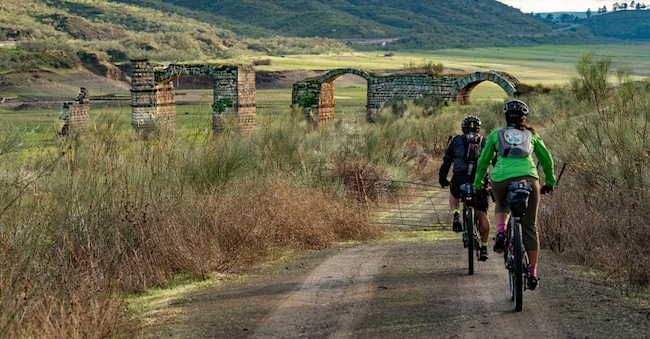
The Vía Verde Ruta de la Plata is one of the longest and best known in Spain and uses the route of the old Plasencia-Astorga railway line, inaugurated at the end of the 19th century and decommissioned in the 1980s. Currently, more than one hundred and ten kilometres have been upgraded for cyclists and hikers, but one of the best known stretches is the one between Plasencia and Béjar: a route of around sixty-five kilometres, simple and suitable for cycling without major differences in altitude. The Vía Verde Ruta de la Plata crosses a very varied territory: it stretches from Plasencia, capital of Jerte in the Extremadura region, through the Ambroz valley and pastures, passing through oak and deciduous forests. We intercept small towns such as Aldeanueva del Camino, where it is easy to come across the ancient Via de la Plata of Roman origin, and the picturesque village of Hervás, known for its historical and cultural heritage left by the Jewish community. Finally we reach Béjar, in Castilla y Léon, which is worth a visit for its historical and cultural heritage, including the Renaissance complex of Villa del Bosque, as well as for its interesting 19th and 20th century industrial heritage linked to the textile sector, to which the museum located on the banks of the Cuerpo de Hombre river is dedicated. It is particularly impressive to end this Green Way on the slopes of the high, snow-capped peaks of the Sierra de Béjar, declared a Biosphere Reserve.

