
Deterrence in the Middle East

The effects of the US bombs. Iran is taking steps (legally) to withdraw from the uranium agreement

Following the attacks on nuclear facilities, there is no up-to-date information on material stocks. In Tehran, there is talk of invoking Article X of the NPT, the Nuclear Non-Proliferation Treaty. The aim: to renounce all IAEA obligations. Not exactly a success for the White House

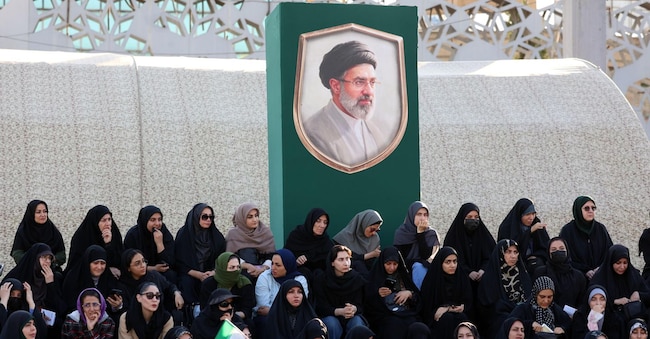
Donne iraniane sotto l’immagine del leader supremo, l’ayatollah Mojtaba Khamenei, presso il campo di addestramento militare Jan-Fada (Sacrificati per l’Iran),  a Teheran EPA/ABEDIN TAHERKENAREH

6' min read

Translated by AI
Versione italiana

6' min read

Translated by AI
Versione italiana

The trigger for the US attack on Iran seems to have taken a back seat. It has almost been forgotten. Yet Tehran’s approach to nuclear power has changed in nature and direction. Following the air strikes against Iran’s nuclear infrastructure between 13 and 24 June 2025 and the new round of military operations in 2026, the issue is no longer merely a matter of determining how much uranium Tehran has enriched, which obligations it has complied with or breached, and what scope remains for resuming inspections by the International Atomic Energy Agency. The question now is whether Iran continues to regard it as beneficial to belong to a system that recognises its right to the peaceful use of nuclear energy and verifies its activities, but which offers it no military protection against an attack. It is this rift between verification and security that explains why a delicate debate has flared up in Iran over withdrawing from the Nuclear Non-Proliferation Treaty, the NPT.

Iran, as a non-nuclear-weapon State, is bound by Article II not to acquire them; Article III links this obligation to the IAEA’s safeguards; Article IV safeguards the right to the peaceful uses of nuclear energy; Article X allows a State to withdraw if it considers that extraordinary events have compromised its supreme interests, subject to three months’ notice.

Loading...

In June 2025, facilities – including Fordow, Natanz and Esfahan – were targeted, whilst the IAEA was forced to suspend part of its on-the-ground activities and withdraw its inspectors for security reasons. The attacks of 2026 then reinforced, in the most radical Iranian interpretation, the view that membership of the non-proliferation regime ensures transparency to the outside world without guaranteeing invulnerability from within.

This is a crucial distinction, because the NPT is not a collective defence treaty. It does not oblige other members to protect a facility subject to safeguards, it does not provide for an automatic military response against those who attack it, and it does not contain a security mechanism comparable to that of an alliance. This gives rise to Iran’s new argument: if the burden of transparency remains whilst physical protection is lacking, how much is the original compromise still worth?

SITUAZIONE PRIMA DEGLI ATTACCHI DEL GIUGNO 2025

Loading...

Stocks of enriched uranium

Prior to the attacks in June 2025, the IAEA estimated that Iran possessed a total of 9,874.9 kilograms of enriched uranium, of which 440.9 kilograms had been enriched to 60 per cent U-235; 432.9 kilograms of this latter quantity had been verified directly by the Agency. During the same period, over 20,000 centrifuges were reported to be installed, distributed across 125 industrial-scale cascades at the declared sites.

With access to several sites having been cut off, the IAEA has lost the continuity of knowledge required to determine, with the same degree of reliability, the location of all the material, the chemical form in which it is stored, and how the configuration of damaged or rebuilt facilities has changed. In June and September 2026, France, Germany, the United Kingdom and the United States argued before the IAEA Board of Governors that the Agency had been unable to verify highly enriched material and the most sensitive facilities for almost a year, insisting on the need to restore access.

A new deterrence scenario

This is the most important distinction in the entire Iranian dossier. Tehran could formally invoke Article X and withdraw from the NPT without deciding to build a nuclear weapon. It could, on the other hand, breach its obligations before withdrawing. It could produce material enriched to over 60 per cent without yet possessing a device. It could theoretically build a device without having an operational nuclear force. Deterrence requires much more than fissile material. It requires a delivery system, a secure political and military command structure, communications capable of surviving an attack, authentication procedures, the ability to protect or disperse weapons and, above all, the credibility that a retaliatory capability will remain operational after a first strike.

It is precisely the transition from capability to deterrence that constitutes the most dangerous aspect of a possible future decision by Iran. An adversary that considers Tehran to be close to nuclear capability but not yet in possession of a survivable force may conclude that there is a window of opportunity in which a pre-emptive strike is still possible. Iran may reach the opposite conclusion: that its own vulnerability makes it necessary to accelerate the development of the capability that should prevent the next attack. The attacks of 2025 and 2026 thus appear to reinforce, within Iran, the conviction that only nuclear deterrence can prevent further operations; at the same time, they demonstrate just how vulnerable a programme is in the period prior to the establishment of credible deterrence.

Italy’s position

For Rome, the Iranian crisis is not merely a Middle Eastern issue. It directly concerns the stability of the non-proliferation framework on which Italia bases a substantial part of its nuclear security policy. On 15 September 2026, the Under-Secretary of State for Foreign Affairs Massimo Dell’Utri, leading the Italian delegation at the 70th General Conference of the IAEA, reaffirmed Italy’s support for the Agency’s role in security, non-proliferation and the peaceful uses of nuclear energy. Italy formally regards the NPT as the cornerstone of the international non-proliferation regime and supports the extension of the IAEA’s verification capabilities and the Additional Protocol.

This position has practical implications for the Iranian issue. In May 2026, during the 11th NPT Review Conference, Ambassador Leonardo Bencini, Italia’s Permanent Representative to the Conference on Disarmament, reiterated that Iran must not acquire nuclear weapons and must cooperate with the IAEA. The Conference concluded on 22 May 2026 without a consensus final document, and the Italian delegation identified the reference to Iran’s non-compliance as one of the main points of contention. In September 2026, Italia was listed among the co-sponsors of the resolution tabled before the Board of Governors on the Iranian issue, whilst Ambassador Debora Lepre, Permanent Representative to the international organisations in Vienna, confirmed Italy’s support for the central role of the IAEA. For Italia, therefore, an Iranian withdrawal from the NPT would pose a problem that goes beyond relations with Tehran: it would weaken a verification system that Rome defends as a tool for security, nuclear industrial policy and technological cooperation. Italy’s interest is therefore particularly tied to the survival of the distinction between the right to peaceful use and military proliferation. Without that distinction, the Iranian issue ceases to be a dispute over compliance and becomes a precedent concerning the very stability of the regime.

Loading...

The German position

The federal government in Berlin, for its part, continues to regard the NPT as the cornerstone of the international nuclear order and calls for full transparency from Iran and IAEA access to the disputed facilities. This approach makes it particularly difficult for Germany to separate a possible Iranian withdrawal from the NPT from the economic dimension. Germany may support negotiations that recognise civilian nuclear rights and lead to the easing of sanctions, but the German approach remains centred on verifiability. The less verifiable the programme becomes, the more difficult it becomes to politically chart a course towards economic normalisation. Withdrawal from the Treaty would therefore complicate the very leverage that Berlin is best placed to exert: transforming economic restrictions and market access into quid pro quos for measurable nuclear commitments.

These differences would become significant should Tehran actually issue the notification required under Article X. From that moment, a three-month period would commence during which any decision taken by Iran — regarding centrifuges, 60 per cent enriched uranium, access for inspectors, the reconstruction of sites, the safeguarding of material and the relationship between the civilian programme and military facilities — would carry greater weight than any parliamentary declaration.

For Iran, prolonging this grey area means keeping its options open, but also maintaining a high risk of new military operations and further financial isolation. For Europe, it means deciding how much longer diplomacy and sanctions can secure verifiable access before the issue becomes one of deterrence. For Italia, it means defending a multilateral framework on which the broader credibility of the IAEA and non-proliferation also depends. We shall see what happens. It would certainly not be a success for the United States.

Copyright reserved ©
Loading...

Brand connect

Loading...

Newsletter

Notizie e approfondimenti sugli avvenimenti politici, economici e finanziari.

Iscriviti