

With gas from the Sahara, the EU is aiming to break free from Putin. Moscow, however, wants to build the pipelines
Europe risks finding Russian companies involved in the development of infrastructure designed to diversify its energy supplies. Algeria has begun work on the TSGP pipeline, which links Nigeria, Niger and Algeria. The Algerian Foreign Minister, Ahmed Attaf, met his counterpart, Lavrov, to discuss industrial cooperation

Key points
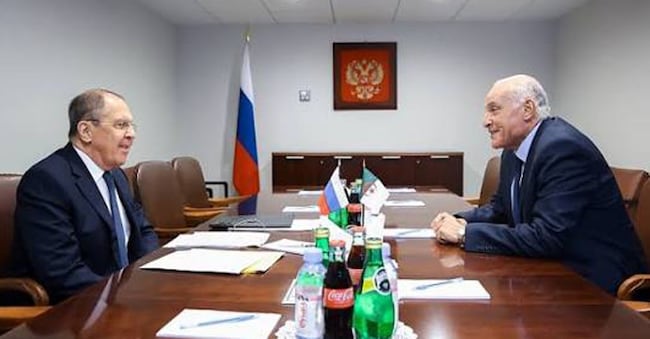
Europe wants to move away from Russian gas, but may find itself working with Russian companies on the construction of infrastructure designed to diversify its supplies. On 4 June 2026, Algeria began work on its section of the Trans-Saharan Gas Pipeline (TSGP), which is set to link Nigeria, Niger and Algeria. On 27 October, in Moscow, the Algerian Foreign Minister Ahmed Attaf met his Russian counterpart Sergey Lavrov, whilst prospects for Russian industrial involvement in the project were emerging. At present, these are merely preliminary discussions that have not yet resulted in any signed contracts.
The project involves a pipeline of approximately 4,200 kilometres, with pipes of a stated diameter of 48 inches and an initial capacity of 20 billion cubic metres per year, expandable to 30. On 3 June, the tripartite committee approved an updated feasibility study, commissioned from Penspen; the following day, Sonatrach announced the start of works at Aoulef, in Algeria, along the planned corridor towards Hassi R’Mel.
The section most affected by the gap between announcements and implementation is the one in Niger. On 17 March 2026, a mission from Sonatrach to Niamey began examining the route, authorisations, environmental studies and technical procedures. Work on the more than 700-kilometre route is scheduled to begin in early 2027. We shall see. A delay in Niger would also postpone the returns on the Algerian investment, whilst the financial costs would remain the same.
Announced capacity and the actual market
According to the European Commission, in 2025 the EU imported 289 billion cubic metres of gas, of which 36 billion came from Russia, compared with 52 billion in 2024. LNG imports totalled 131 billion cubic metres, accounting for around 45 per cent of the total. The pipeline’s initial capacity of 20 billion would represent 6.9 per cent of European purchases in 2025; the 30 billion from the possible expansion would account for 10.4 per cent. If the pipeline were to operate at 50 per cent of its initial capacity, it would transport 10 billion cubic metres; at 90 per cent, 18 billion. Not all of these volumes would necessarily be destined for the EU.
Nigeria has the resources to make this prospect credible, but the documents examined do not yet provide the commercial evidence required to quantify the gas flows destined for the TSGP. The Nigerian regulatory authority has reported gas reserves of 215.19 trillion cubic feet: 100.21 trillion cubic feet of gas associated with oil production and 114.98 trillion cubic feet of non-associated gas. To transport 20 billion cubic metres per year, an average flow of 54.8 million cubic metres per day would be required; to reach 30 billion, 82.2 million.

