
28 July 2025
US tariffs at 15% on cars, drugs and chips. White House: EU will not tax digital networks and invest 600 billion
From Legacoop to Confcommercio, from Acea to Federacciai and Confcooperative: the concern about price increases of trade associations
For feedback, please contact
english@ilsole24ore.com
 Aggiungi Il Sole 24 Ore
ai preferiti su Google
Summary by points
- EU sources: 'Liberalisation targeted at US agribusiness'
- Sefcovic: without agreement, EU-US trade would have collapsed
- EU sources, no engagement with US on digital rules nor web tax
- EU sources: on US tariffs exemptions for wine we negotiate"
- EU sources: 'No tariffs on drug chips now, 15% cap'
- EU sources: 'Counter-duties will be suspended from 4 August'
- Acea, EU-US agreement important but impact on sector will be negative
- Von der Leyen: '15% on the car is the best we could'
- U.S. tariffs at 15% on Italian wine: 317 million impact. Frescobaldi: "At least 80% of the sector penalised"
- EU and US work on common steel and aluminium quotas
28 July 2025Pinned update
US, 15% tariffs on cars, pharmaceuticals and chips
"The EU will pay the US a 15% tariff rate, including on cars and auto parts, pharmaceuticals and semiconductors. However, sectoral tariffs on steel, aluminium and copper will remain unchanged: the EU will continue to pay 50 per cent and the parties will discuss the security of supply chains for these products": this is one of the passages of the fact sheet released by the White House on the trade agreement reached yesterday between the US and the EU.
28 July 2025
Cia: heavy bill for Italian agri-food products
"More than an agreement, the 15% tariffs deal looks like a surrender. Now Made in Italy agri-food exports to the US (EUR 7.8 billion in 2024) risk big losses in key sectors such as wine, oil, pasta and rice, and dairy, without getting anything in return. In addition to the direct impact, there is also the danger of serious damage to the entire agro-industrial sector, with heavy repercussions on employment'. This is how the President of Cia-Agricoltori Italiani, Cristiano Fini, comments on the agreement between the President of the EU Commission, Ursula Von der Leyen, and the US President, Donald Trump.
'Although the 30 per cent tariff has been avoided, there remains great concern about the real impact of these tariffs, but before drawing any final conclusions we want to wait for developments in the coming days, with the official definition of the customs lists,' Fini continued.
According to Cia, the concrete risk of a drop in exports is very high, with damage to strategic sectors and an increase in costs for Italian companies, which will tend to lose profit margins or have to pass on part of these costs to consumers, risking reducing demand in the US market. The combined effect of tariffs and fluctuations in the euro-dollar exchange rate will only exacerbate the impact of customs measures, translating into real additional costs for domestic companies and making Italian products less competitive.
For wine, the USA is the world's number one market with about EUR 1.9 billion in sales in 2024. Most dependent on the United States for their exports are the PDO white wines of Trentino-Alto Adige and Friuli-Venezia Giulia, with a 48% share and an export value of 138 million euros in 2024; Tuscan PDO red wines (40%, 290 million), Piedmontese PDO red wines (31%, 121 million) and Prosecco PDO (27%, 491 million). Large numbers that tariffs may upset, leaving the way clear for competitors: from Argentinian Malbec to Australian Shiraz to Chilean Merlot.
As far as the world of oil is concerned, the 15% tariffs risk reducing the competitiveness of Italian extra virgin in favour of cheaper oils from third countries with lower tariffs, such as Turkey, South America or Tunisia. As a consequence, the average US consumer will be induced to use other oils, such as traditional seed oils (sunflower, soya, maize).
At present, the United States is the main extra-EU market for Italian oil, with a quota of about 100 thousand tonnes per year and a value close to 1 billion, or 32% of our exports. There is also fear because these new tariffs will affect all the main European producer countries (Italy, Spain, Greece) across the board, with the consequence of a possible oversupply on the domestic market, which would lead to a general depreciation of Italian oil.
In the dairy sector, on the other hand, tariffs will mainly affect PDO cheeses such as mozzarella di Bufala, as well as Pecorino Romano cheese used overseas by the food industry to flavour potato crisps in bags and other snacks. Also at risk are pasta, rice and flour, among the most popular products in the US market, with annual exports of about 2 billion and almost half a million tonnes shipped overseas. In this sector too, according to Cia, there is a risk of potential job losses if tariffs are not mitigated with agreements or support measures.
28 July 2025
Orsini: Immediate measures for investment and business productivity
To support companies in the face of the challenges linked to US trade tariffs, Italy must immediately put in place 'measures that incentivise investment and succeed in increasing productivity'. This was stated by the president of Confindustria, Emanuele Orsini, interviewed by Tg1 Rai on the political agreement just reached between the US and the EU on trade tariffs.
"For us everything beyond zero is a problem. Today the impact of 15% tariffs means for Italian companies 22.6 billion of probable sales to the US,' he noted. 'But we are underestimating one thing, which is not only the impact of tariffs, but also the devaluation of the dollar-euro, which for us means increasing the duty by 13%, which other non-European countries have an average of 2%, which is difficult to recover.
Orsini cited the case of pharmaceuticals: 'We know that there is a negotiation. We cannot expect tariffs of over 15% to be passed here as well, because it is already one of the sectors that will be hit hard, along with all the machinery and tools that go to the US,' he said.
On the measures to be put in place to support companies, 'it is not just a matter for the Italian government but for Europe. Europe must also compensate for the lack of competitiveness of our products towards the United States and help those sectors that are most affected," said the number one of Confinfustria. "It must immediately implement a new extraordinary industrial plan for companies. It is good to overstretch the Stability Pact for arms and defence, but we must also do so for industry and go immediately to make agreements with new markets, where we could be strong and partly replace the loss we have in the United States".
"On the Italian side, we must immediately put measures on the ground that incentivise investment and above all succeed in increasing productivity," he concluded.
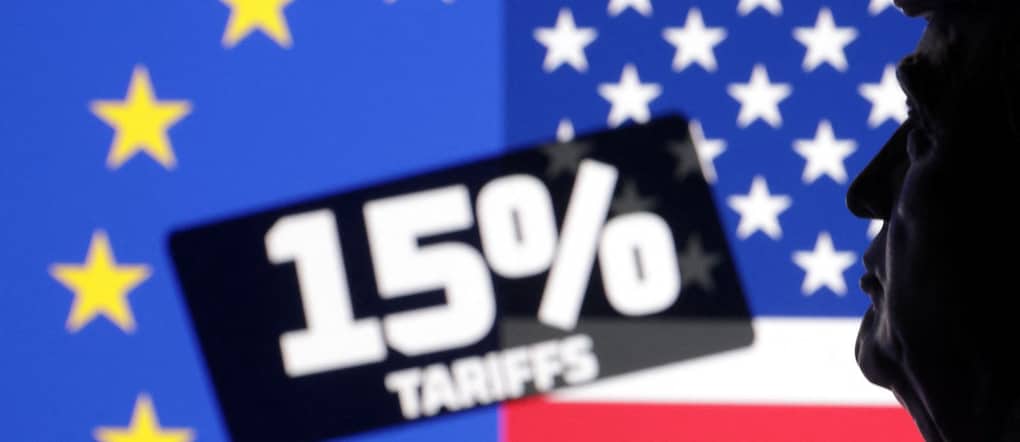
A 3D-printed miniature of U.S. President Donald Trump, U.S. and EU flags and words "15% tariffs" are seen in this illustration taken July 27, 2025. REUTERS/Dado Ruvic/Illustration
Ask the editorial team
Have questions or feedback about this article? Contact our editorial team.
28 July 2025
Tajani brings business together after US-EU agreement, task force set up
The Minister of Foreign Affairs and International Cooperation, Antonio Tajani, today held a meeting at the Farnesina on tariffs following the agreement reached between the European Union and the United States. The meeting was attended by the Italian System agencies - Ice, Sace, Simest, and Cdp, the Italian Permanent Representation in Brussels, the Italian Embassy in Washington, and representatives of various production associations including Confindustria, Coldiretti, Confapi, Confagricoltura, Cna, Confimi Italia, Federacciai, Farmindustria, Confesercenti, Confartigianato, Confcooperative, Confcommercio, Federlegno, and Federvini.
Minister Tajani first of all announced the establishment of a permanent task force on tariffs at the Farnesina to provide support to businesses, and explained how negotiations with US counterparts will go ahead over the next few days to better define the details in certain sectors, including some of specific interest to Italy, such as the wine-growing sector. During the meeting, the contents of the agreement in principle reached between the European Commission and the United States were then illustrated, which envisages a horizontal tariffs on European goods of 15%, including the average tariffs in force under the WTO, equal to 4.8%. The understanding will take shape through a joint declaration with the US (framework understanding), which is expected to be finalised at the technical level in the coming days. The joint declaration is not legally binding. The commitments contained therein would be declined at a later stage in a (legally binding) reciprocal trade agreement.
The agreement includes - among others - zero-for-zero products, a European commitment to increase purchases from the US, a political commitment to work together to keep critical minerals supply chains open, and a European commitment to take 'American concerns' into account in the context of the simplification agenda.
The Italian government has already asked Brussels to activate a European monitoring service on the impact of the tariffs agreement and will also continue to work to strengthen the Single Market, simplify rules, diversify trade relations and reduce our dependencies. - In this perspective, the government reiterates its strong commitment to pursue with determination the strategy of diversification of export destination markets, through the implementation of the Export Action Plan in non-EU high-potential markets to accompany Italian companies towards new high-growth markets and promote the internationalisation of the national production system. This strategy is also based on the strengthening of Ice's promotional tools, including those concerning the participation of Italian companies in trade fairs of international importance, on Simest's subsidised financing, and on a further broad extension of Sace's Push Strategy to reach new markets and new international clients.
28 July 2025
White House, no tariffs for digital networks from EU
"The United States and the European Union intend to tackle unjustified barriers to digital trade. In this regard, the European Union confirms that it will not adopt or maintain tariffs on network use. In addition, the United States and the European Union will maintain zero tariffs on electronic transmissions'. This is what is stated in the fact sheet released by the White House on the trade agreement reached by the US and the European Union.
28 July 2025
US, EU to invest 600 bn, in addition to the 100 bn of EU companies
"The EU will invest $600 billion in the US during President Trump's term. This investment is on top of the more than $100 billion a year that EU companies already invest in the US. The EU will double its dependence on the US as an energy superpower by purchasing $750 billion of energy exports by 2028. This will strengthen US energy dominance, reduce European dependence on rival sources, and reduce the trade deficit with the EU'. This is one of the passages of the fact sheet released by the White House on the trade agreement reached yesterday between the US and the EU.
28 July 2025
Pichetto: 'We always say 'do more' but maybe it was difficult'
"When you have to come to an agreement, you try mediation and then clearly the judgement is always that you could say 'you could do more'. But perhaps it was difficult to do more'. This is how the Minister for the Environment and Energy Security, Gilberto Pichetto Fratin, commented on the political agreement on commercial tariffs reached yesterday by the EU and the US, during an interview 'Green Europe and the challenge of the future', organised as part of the 'PiazzAsiago' event.
28 July 2025
Euro slips on fears of tariffs impacts
The euro weighed down on currency markets in the wake of fears over the impact that the tariffs agreement will have on the Old Continent's economy. The single currency dropped 1% to $1.1623, on the session's lows, while optimism about the end of the uncertainty linked to the agreement reached between the EU and the United States seemed to be short-lived.
28 July 2025
Assica, 15% of Italian cured meat companies at risk of crisis, need to confront the USA
The announcement of the imposition of new 15% tariffs on European cured meats by the Trump administration risks putting one of the most strategic markets for the Italian sector in crisis: the United States, which in 2024 was confirmed as the third destination for exports of Italian cured meats, with over 20,000 tonnes exported (+19.9%) and a turnover of 265 million euros (+20.4% compared to 2023). This is the alarm raised by Assica, the Association of Meat and Cured Meat Industries, the national trade organisation that, as part of Confindustria, represents companies involved in the production of cured meats (both pork and beef), pig slaughtering and the processing of other meat products. "The tariff increase represents a significant brake for our companies, which already operate in an extremely unstable global environment. Both Italian producers and US consumers, who will face inevitable price increases, will be affected," commented Lorenzo Beretta, president of Assica. "Unlike in 2019, when the measures only affected specific types of products, today the customs tax applies to the entire category of cured meats, with a particularly heavy impact on raw hams, which are the main export item to the US," he continued. This scenario is part of an already critical context for the Italian meat and cured meat industry, which has been severely penalised on the export front by the spread of African Swine Fever (ASF). The resulting health restrictions have led to the closure of important markets such as Japan and China, further reducing international outlet opportunities.
28 July 2025
CGIL, 'President of the Council urgently convene the social partners'.
'We ask the Prime Minister to urgently convene all the social partners to assess the overall picture of the fallout in each sector and the measures needed to protect workers and safeguard our production fabric'. Thus the confederal secretary of the CGIL, Christian Ferrari.
"If the anticipations were confirmed, the European Union would not have averted the trade war with the US, it would first have suffered it without reacting, and then lost it with an unconditional surrender by the Commission and the national governments, starting with the Italian one. Pending the formal agreement, and the full picture of the repercussions on the various production sectors, this appears to be the substance of what happened. To realise this, it is enough to list the points of what, rather than a political agreement, resembles an authentic capitulation'. Thus the confederal secretary of the CGIL, Christian Ferrari. 'While European goods will suffer generalised tariffs of 15% (in addition to the devaluation of the dollar, which weighs a further 13%), American goods will not pay any duty. Then there is the EU's commitment to purchase, over three years, $750 billion worth of American fossil energy goods (gas and oil), exacerbating one of the main factors (the cost of bills) that is undermining the competitiveness of European companies and household budgets. To this,' he adds, 'we have to add further European investments in the US amounting to USD 600 billion, which would be tantamount to relocating our production, creating jobs and income in the US instead of Europe. And again: the purchase of American weapons systems, in accordance with the insane objective - set by NATO - of raising military spending to 5% of GDP'. Moreover, Ferrari continues, 'to thank President Trump for his treatment of us, we should guarantee: the absence of countermeasures on digital and financial services, which ensure the United States a significant trade surplus; the exemption from the global minimum tax, decided in the G7 context, for all American multinationals; the non-application of the digital service tax on US big tech, which will be able to continue to enjoy the tax havens in Ireland, Holland, and Luxembourg; the de facto renunciation of implementing trade relations with China and the Brics, which could represent fundamental outlet markets for our goods'.
Ferrari speaks of 'very heavy repercussions on the continental production system and on employment'. For the confederal secretary, 'without changing such a self-defeating political line, there is a real risk that a perfect storm will be unleashed on the European economy and, in particular, on the Italian economy'. For the CGIL there are, in the immediate future, very precise measures to be taken, both at national and continental level: 'first of all, work must be protected, both with regard to employment levels (through social shock absorbers on the Sure model, also envisaging the prohibition of dismissal, as during the pandemic phase) and to protect incomes (starting with the renewal of all the Ccnl, the de-taxation of contractual increases, the return of the fiscal drag)'. Extraordinary measures and instruments are then needed to prevent relocations to the US, to avoid accelerating the deindustrialisation process even more; in perspective, a true single energy market must be created, with the aim of reducing costs and relaunching renewable sources; it is necessary to redefine an economic and industrial strategy for the EU "that definitively abandons mercantilism and austerity policies and finally unleashes the extraordinary unexpressed potential of European domestic demand, with more expansive common policies (NextGenEu model): to finance public investments in infrastructure, knowledge, health and common goods; to increase real wages for workers; to put in place real industrial policies for the ecological conversion, energy transition and technological innovation of our production system." "The mountain of billions promised to Trump should be earmarked entirely for these purposes. This will not happen without a political and social mobilisation that pushes governments and European institutions to change a course that will otherwise inevitably lead us astray,' he concludes.
28 July 2025
Carney (Canada), crucial stage, room for agreement with US
Canadian Prime Minister Mark Carney said that talks with the White House on a tariffs agreement are at a 'crucial stage' and he believes there may be 'scope for an agreement'. Trump has set a deadline of 1 August for the US and other countries to reach agreements to resolve the current dispute over tariffs. "Negotiations are at an intense stage," said Carney, who went on to reiterate that Canada will not sign an agreement unless it is beneficial to the country's workers. Canadians want a solution, 'but they want the right solution'.
28 July 2025
Sources, EU will zero them out on some US products
As part of the trade deal struck yesterday between the US and the EU in Scotland, the Union pledged to zero tariffs on imports of a number of American agricultural, fishing and industrial products, including cars, which are currently 'docked' with very low tariffs, in the range of '2-4%', so-called 'nuisance tariffs', too low to protect the corresponding European sector. This was explained by a senior EU official in Brussels in the aftermath of the announcement of the agreement that provides for unilateral and generalised US tariffs of 15% on imports from the EU. The list of products identified by the Commission "includes agricultural products, non-sensitive agricultural products and fishery products, as well as industrial products", for a trade volume of about 70 billion imports. The EU is prepared to 'reduce tariffs to zero' as a result of yesterday's discussions. The list should be published in the context of the finalisation of the joint declaration, which should take place by next Friday, 1 August. It concerns, for example, nuts imported from the US into the EU and the extension of the lobster deal, the Lobster Deal, reached in 2020, a mini-trade agreement that provides for zero tariffs on lobsters imported from the US into the EU, in exchange for the reduction of US tariffs on some European products. The list will also include 'certain processed fish', and certain types of 'raw fish'. It also covers 'cheese, some dairy products, pet food'. Even for 'cars' imported into the EU, for which the Union had agreed to go down to the most-favoured-nation tariff of 2.5 per cent, 'we are prepared to go to zero', as well as for some machinery, some chemicals, and fertilisers, the source concluded.
28 July 2025
US-China talks kick off in Stockholm
A new round of talks between the US and China started in Stockholm after the escalation of the tariffs and counter-duties war. Cgtn reports. The talks feature US Treasury Secretary Scott Bessent and He Lifeng, vice-premier and China's economic czar and Xi Jinping's loyalist. Bessent announced the parties' intention to work on a 'likely' extension of the trade truce, which expires on 12 August.
28 July 2025
Brussels defends deal with Trump, better than a trade war
The agreement with the US on tariffs is better than a trade war. It provides stability and predictability to trade and economic relations at a time of acute geopolitical difficulty with the war in Ukraine still far from over and Chinese competition that is no longer just economic-technological. And then the agreement reached on Irish soil between Trump and von der Leyen does not call into question the Union's autonomy in defining the rules of the internal market, starting with taxation and ending with regulations on digital groups. These are the arguments with which the European Commission defended the agreement on tariffs: basically a sense of resignation prevails, certainly not of victory. Trade Commissioner Maros Sefcovic said bluntly at a press conference in Brussels this morning: 'Some people still believe we can go back to the situation before 2 April, I think if you look at the agreements between the US and its trading partners in recent weeks or at the number of letters setting out new tariffs between now and 1 August, it is quite obvious that the world that was there before 2 April has vanished, we simply have to adapt, we have to face the challenges that come with this new approach. The understanding reached is 100 per cent better than a trade war'. This is a position in which most governments, primarily those of Germany and Italy, find themselves. Disappointment in Paris, with Prime Minister Bayrou speaking of a 'dark day', of 'submission' to the US, and in Budapest: for Prime Minister Orban, Trump has 'eaten Ursula von der Leyen for breakfast'.
28 July 2025
Confetra, now to reduce internal trade barriers
"The news of the agreement on tariffs between the European Union and the United States helps to reduce a climate of uncertainty that penalises companies and investments. This long negotiation has highlighted the fragility of Europe, squeezed between the US and China. In order to get out of this situation, we now need to act on our weaknesses, starting with internal trade barriers that continue to hinder the full development of the single market and, with it, our ability to keep up with the major global economies'. So says Carlo De Ruvo, president of Confetra, commenting on the trade agreement reached between Brussels and Washington. 'According to the International Monetary Fund,' De Ruvo continues, 'the current internal barriers are equivalent to an ad valorem cost of 44% for manufacturing goods and even 110% for services. These are hidden costs that are reflected in less competition, higher prices, low productivity and lower incomes. Overall productivity in the EU is today 20% lower than in the US, and even in the strongest European economies per capita income is about 30% lower than the US average'. For Confetra, a decisive change of pace is needed. "The IMF reminds us that a 10% reduction in internal barriers to trade and multinational production could generate a 7% growth in European GDP. This means opening up sectors that are still protected, liberalising services, harmonising regulations and modernising border infrastructures'. 'Europe has what it takes to strengthen its role in the global scenario,' De Ruvo concludes, 'but we need bold choices and structural reforms. The single market must return to the centre of European strategy: it is there that the real challenge of competitiveness and industrial autonomy of our continent is played out'.
28 July 2025
Ucimu: agreement acceptable, wish metal-free machine tools
"The solution found, from our point of view, is acceptable overall. Could it have been better? I would say so, but a much worse scenario could also have been in front of us. So, let's bring this result home while we wait to hear the details'. This was stated by Riccardo Rosa, President of the Association of Italian Manufacturers of Machine Tools, Robots and Automation (Ucimu), commenting on the EU-US agreement on tariffs.
"The focus is also high because the US is our first destination market, with 600 million machines sold in 2024, or 16 per cent of the total exported by our industry," he continued. "The hope is that metalworking machine tools - of which the US is in dire need as it has no local production to meet the particularly demanding domestic demand in terms of technology - will be included in the list of goods exempt from taxation."
"If this does not happen," he emphasised, "Italian machine tool manufacturers, whose offerings are very well accepted in the US market, which appreciates their high technological content and strong customisation, will have to figure out how to handle the 15% tariffs. In any case, we will roll up our sleeves and work as always to satisfy local demand, which has in aeronautics, defence and miscellaneous mechanics its main outlets".
'In any case,' concluded Ucimu's president, 'the meeting set for this afternoon between entrepreneurs and Minister Antonio Tajani, whose target is to reach 700 billion in exports by the end of the legislature, is an important signal of attention to the needs of the production world and a demonstration of willingness to seek possible new ways to contain the distorting effects of this taxation.
28 July 2025
Tariffs, Merz: good, escalation avoided. Positive outcome for automotive


Now the word goes back to Europe and the Member States. To their 'ambassadors', first of all, who were constantly informed during the trip to Greenland organised for them in this weekend by Denmark, the EU's rotating president: they will now have to coordinate very shortly for the first technical assessments. Then will come the time for politics.
The first reactions are not lacking, but they mainly refer to the averted danger on the 30% tariffs: "An unnecessary escalation was avoided," said German Chancellor Friedrich Merz: "The agreement managed to avert a trade conflict that would have hit the export-oriented German economy hard. This is especially true for the automotive industry, where the current tariffs will be almost halved from 27.5 per cent to 15 per cent'. Merz pledged Germany's support for the Commission and wanted to look to the future, to the new situation: he will now demand, he said, tariffs to be reduced and trade barriers to be lowered on other treaties as well, starting with the Mercosur treaty.
28 July 2025
Federpetroli, 15% facade, with compulsory purchases of weapons and energy goes to 30%
"To date it is a mere 15% tariffs, but between energy and weapons we arrive at over 30%, with purchases imposed and not dictated by free trade: it is an absurdity". Thus the president of Federpetroli Michele Marsiglia, asked by LaPresse. "Let's stop the optimism and focus on what the final US-EU agreement will be. Buying 750 billion of energy is not little and we still don't know what kind of energy and above all at what price. Italy and Europe have diversified their energy purchases between Africa and the Middle East. We await the final document of the agreement to study the details, which to date are somewhat unclear. Several European states are not ready for acquisitions of this kind, and if there is talk of LNG, someone in Brussels or Scotland has forgotten that the Commission itself has waged war on our energy companies in the construction of regasifiers,' Marseille concludes.
Further reading

28 July 2025
Analysts, EU-US understanding complicates Mercosur agreement
The preliminary agreement between the United States and the EU creates a new geopolitical and economic context that could complicate the ratification of the agreement between the EU and Mercosur, according to some analysts interviewed by the Brazilian daily Valor Economico. Seen from Latin America, the Brussels agreement with Washington looks more like a 'surrender' on the part of Europe, which accepts the application of 15% tariffs on its products to the United States, while not taxing most American goods arriving on its market. According to Olivier Blanchard, former chief economist of the International Monetary Fund, "this is an unequal understanding. Moreover, it creates an environment of increased economic and political pressure for the EU: 15% tariffs, Brussels' billion-dollar commitments for US investments, and energy purchases drain the European bloc's resources. On the other hand, the absence of tariffs on US exports to the 27 also poses a competitiveness problem for Mercosur products, which are instead subject to tariffs. And the promise to buy $750 billion worth of American energy, especially liquefied natural gas, could also reduce potential European demand for South American countries. Finally, French and Polish farmers, given the arrival of zero-tariffs US products on the European market, could also offer more resistance to Mercosur products.
28 July 2025
Tuscan PDO and PGI Wines Association calls for institutional intervention
"The tariffs imposed by the United States represent a negative event for our sector and will have important repercussions on consumption and therefore on the economies of our companies operating in one of the strategic sectors of Tuscany, but also of the country". This is what Andrea Rossi, president of A.VI.TO. the Tuscan Wines PDO and PGI Association, thus representing 24 Tuscan wine protection consortia, and the Consorzio del Vino Nobile di Montepulciano, says.
In particular, the Tuscan wine association reiterates the importance of structural intervention on the part of the government and institutions to make extraordinary resources available to cope with this new and important change. "We are also asking for greater flexibility in the promotion tools, starting with the CMO; therefore, thinking together with the production world of new strategies and investments in new markets, seeking integration with respect to the United States," continues Rossi, who recalls how this new variable follows others that have taken place in recent years.
"We have come from five years very much affected by events of various kinds: first the pandemic, then the spike in energy costs, the unconditional increase in interest rates, the downy mildew, all events that could not be controlled and could not be foreseen by producers who have nevertheless tried to react, but at this point it is our duty to ask the institutions to support such an important sector with extraordinary interventions, such as the wine sector," concluded Rossi, who in recent days had signed a letter addressed to the relevant Italian ministries, the European negotiators, the Region of Tuscany, and the presidents of Federdoc and Unione Italiana Vini, to ask for attention and support for Tuscan wine companies on the issue of the tariffs once again announced by the Trump government. The US market for Tuscan wine represents 37% of exports with an average annual value of over 400 million euros.
A.VI.TO.'s letter also indicated possible measures to ease the burden of tariffs on companies, in order to encourage the development of alternative markets to the United States, such as speeding up the ratification of free trade agreements through Mercosur and any other international agreements, as well as the need to simplify the use of CMO funds that are now weighed down by the heavy bureaucratic burden required.
Established in 2016, A.VI.TO. represents the first unitary body representing quality Tuscan wine-growing. At present, 24 Consorzi di tutela (consortia) are members, for about 6,000 enterprises and just under 60,000 hectares of vineyards with a production that, in 2024, reached about 260 million bottles. The consortia that are part of A.VI.TO. represent the following Tuscan denominations: Bianco di Pitigliano and Sovana, Bolgheri and Bolgheri Sassicaia, Brunello di Montalcino, Vino Chianti Classico, Chianti Colli Fiorentini, Chianti Colli Senesi, Vino Chianti, Chianti Rùfina, Vini delle Colline Lucchesi, Morellino di Scansano, Vino Nobile di Montepulciano, Carmignano Wines, Cortona Wines, Montecucco Wines, Orcia Wines, Valdarno di Sopra DOC Wines, Vernaccia di San Gimignano Wines, Maremma Toscana Wines, Valdichiana Wines, Terre di Pisa Wines, Suvereto and Val di Cornia Wines, Terre di Casole Wines, and Pomino Wines.
28 July 2025
De Meo, 'agreement with US foils trade war'
"The agreement between the European Union and the United States on tariffs is, all things considered, the best possible outcome, given the difficult and increasingly unpredictable interlocutor. A trade conflict that would have hit our economies hard and weakened the entire Western front has been avoided'. Thus in a note Salvatore De Meo, Forza Italia MEP and President of the EU-NATO delegation. "The agreement is still in principle and has several aspects to be clarified, starting with exemptions, application criteria and the impact on some sensitive sectors. We must therefore continue to work with determination to obtain a more comprehensive and sustainable agreement and, at the same time, work to ensure, at national and European level, effective support measures for the sectors that risk being penalised the most,' the MEP explains. 'Finally, we need serious reasoning on what Europe can do to strengthen itself. It is essential to speed up the simplification of rules, the cutting of red tape, the diversification of trade agreements and the reduction of our strategic dependencies. It is on this ground that, as Forza Italia in the European Parliament, we will continue to fight with determination to correct the ideological course taken during the last mandate and bring back to the centre pragmatic policies that reflect the real needs of citizens and businesses,' De Meo concludes.
28 July 2025
EU sources: 'US car tariffs will drop to 2.5 per cent'
The EU has agreed to reduce import tariffs on cars from the US from the current 10 per cent to 2.5 per cent as part of the trade agreement with Washington. This was reported by EU sources, outlining some of the main points of the agreement reached yesterday, which envisages a lowering of US tariffs on continental autos from the current 27.5 per cent to the general rate of 15 per cent. The commitment 'to work together on car standards' is confirmed, similar to what the US has agreed with Japan. Some areas, such as connected vehicles, already show convergence between the EU and the US, while for others, such as nitrogen oxide (NOx) emissions, the differences are still significant. "There is still no mutual recognition of standards, but the goal is to gradually come closer to facilitate market access," the same sources point out.
28 July 2025
Carmignac, EU accepts unfavourable terms for geopolitical reasons
"At first glance, the trade agreement between the United States and the European Union offers little for Europe to celebrate. European exports to the United States will now be subject to a 15% customs tax - ten times higher than the pre-trade war level of 1.5%. However, what appears to be a capitulation of the EU deserves a more in-depth analysis on three fundamental dimensions'. Thus Apolline Menut, economist at Carmignac, in an analysis of the tariffs agreement signed yesterday between the United States and the European Union. For Menut, 'this is not a trade breakthrough, but a damage limitation operation, in the name of diplomatic pragmatism. The EU has accepted disadvantageous conditions to preserve geopolitical alignment. The economic cost may be felt, but the strategic calculation is cruelly rational'.
"The agreement averts the worst case scenario: the 30% tariffs threatened by Trump, a chaotic escalation of retaliation and an all-out trade war. Europe, unlike China, does not possess strategic economic and technological leverage in the crucial nodes of global industrial supply chains. It is true that US manufacturers are more dependent on European suppliers of intermediate goods than the other way around, but in the event of an eye-for-an-eye escalation, Trump could have extended the confrontation to include restrictions on the supply of energy raw materials and digital services to the European economy - areas in which the EU is completely dependent on the US,' Menut adds.
28 July 2025
EU sources: 'Liberalisation targeted at US agribusiness'
The EU has agreed to zero tariffs on a number of non-sensitive agri-food products from overseas, worth around EUR 70 billion of imports. This was stated by EU sources, explaining that on certain categories the current tariffs of between 2-4% will be eliminated. Products included include nuts, soya, lobsters, fish, cheese, some dairy products, pet food, fertilisers and some chemicals, the latter also as an alternative to Russian supplies. "There is no concession on sensitive agricultural goods": "no beef, sugar, ethanol or poultry are included".
28 July 2025
Sefcovic: without agreement, EU-US trade would have collapsed
"Let us pause for a moment and consider the alternative" to the tariffs agreement reached with Washington: "a trade war may seem attractive to some, but it has serious consequences. With tariffs at 30% or more, our transatlantic trade would grind to a halt, putting almost 5 million jobs, including in SMEs in Europe, at serious risk". EU Trade Commissioner Maros Sefcovic said this during a press point. "Our companies have sent us a unanimous message: avoid escalation and work towards a solution that delivers immediate results," he added
28 July 2025
EU sources, no engagement with US on digital rules or web tax
"During these negotiations, both at technical and political level, we have strongly defended our regulatory autonomy. Therefore, there is no commitment to digital regulation, nor to digital taxes, which do not fall within the competence of the EU. We have therefore strongly defended and protected our right to regulate, and this has been an important goal, also in these negotiations'. This was stated by a European Commission official during a technical briefing with journalists in the aftermath of the agreement reached between the EU and the US.
28 July 2025
Tariffs, Coldiretti: 15% EU aid needed for hardest hit sectors
"The agreement with 15% tariffs is certainly an improvement on the initial hypothesis of 30%, which would have caused damages of up to EUR 2.3 billion for American consumers and for the Made in Italy agri-food industry. However, the new tariff structure will have differentiated impacts between sectors and must be accompanied by European compensation for the sectors penalised also considering the devaluation of the dollar. We must wait to understand the terms of the agreement and above all to read the list of zero tariffs agri-food products on which we hope the EU Commission will work to include, for example, wine, which would otherwise be heavily penalised'. This was stated by the President of Coldiretti, Ettore Prandini, commenting on the agreement found between Europe and the US after yesterday's meeting between US President Donald Trump and the President of the European Commission Ursula Von der Leyen. As already stated, Coldiretti emphasises that agri-food products that do not meet the same health, environmental and social standards imposed on European companies cannot be allowed into Italy. It is essential that the European Union continues to firmly defend the system of Geographical Indications, which represent a guarantee of quality and origin, and a cultural and economic protection of our food.
28 July 2025
EU sources: 'Arms purchases are not part of the tariffs deal'
Arms procurement is not an issue for the European Commission and in the negotiation package on tariffs with the United States 'no specific figures have been included': 'it is rather an expectation expressed by President Trump regarding increased defence spending in Europe, which could translate into more orders for the US military industry. But it has not been included in the official calculations'. This was stated by EU sources in the aftermath of the trade agreement with Washington.
28 July 2025
Sources: 750 bn energy from US estimate, not commitment
The 750 billion euro worth of energy commodities, 'oil, gas and nuclear', that the US is supposed to sell to the EU in three years, which US President Donald Trump spoke about, is not an EU 'commitment', because it will not be the European Commission that will buy them, but private European 'companies'. This was explained by a senior EU official in Brussels in the aftermath of the US-EU trade agreement.
28 July 2025
EU sources: 'We will negotiate on US tariffs exemptions for wine'
"Negotiations" on possible exemptions for wine "are still ongoing, at the moment there is no precise timeline, but there seems to be more significant progress on the spirits front". This was explained by EU sources in the aftermath of the agreement on tariffs reached with the United States that envisages a 15% tariff also for European agri-foodstuffs with some exceptions to be defined. (ANSA).
28 July 2025
Tariffs: sources, US tariffs for drugs at 15%
The tariffs that the US will apply on medicines imported from the EU "will be at 15%", as for semiconductors. This was clarified by a senior EU official in the aftermath of the agreement reached on tariffs between President Donald Trump and European Commission President Ursula von der Leyen. Trump, he explains, "wanted to make it clear that they have a free hand on how to conclude the ongoing investigations" based on Article 232 of the Trade Expansion Act of 1962, but "it is clear that for the EU, once tariffs are introduced on medicines, they will be at 15 per cent and the same applies to semiconductors, because these are two negotiations that are almost concluded".
28 July 2025
Lavrov: 'US agreement a blow for the EU'
The tariffs agreement with the US is for the EU 'a hard blow' that will accelerate the deindustrialisation of Europe. This was said by Russian Foreign Minister Serghei Lavrov as quoted by Russian agencies.
28 July 2025
Bayrou: 'Sad day for Europe that has decided to submit'
"It is a sad day when an alliance of free peoples, united to assert their values and defend their interests, decides to submit". This is how the French Prime Minister François Bayrou criticised the EU-US trade agreement signed yesterday in Scotland by which Brussels accepts 15% tariffs on important European products in the US and commits itself to purchasing $750 billion of US energy, intended in particular to replace Russian gas, and to making $600 billion in additional investments in the US.
28 July 2025
EU sources: 'Counter-duties will be suspended from 4 August'
The European Commission is waiting for the US executive orders for the introduction of the 15 per cent tariffs to be effectively adopted on 1 August and, immediately afterwards, plans to suspend the EU countermeasures as of 4 August, thus avoiding the activation set for 7 August. This was reported by EU sources in the aftermath of the tariffs agreement reached with the US The countermeasures, already approved by the Member States, remain ready and could be reactivated if necessary. However, the same sources specify, "it is not from this hypothesis that we will start the new phase of transatlantic relations".
28 July 2025
Acea, EU-US agreement important but impact on sector will be negative
"The EU-US agreement is an important step towards alleviating the high level of uncertainty that has characterised transatlantic trade relations in recent months and Acea welcomes this development in principle. However, the US will maintain higher tariffs on cars and car components, and this will continue to have a negative impact not only on the EU industry, but also on the US industry'. This was the stance of Sigrid de Vries, Managing Director of the European Automobile Manufacturers' Association.
28 July 2025
Gardini (Confcooperative): agreement on tariffs averts trade war
"The agreement reached between the European Union and the United States puts an end to a phase of uncertainty after months of instability that risked leading us into a trade war that our companies would not have been able to withstand. However, we cannot hide our concerns: the tariffs at 15%, although lower than the initial threats of 50% and then 30%, in addition to the devaluation of the dollar are still a significant burden for the European production fabric'. So says Maurizio Gardini, president of Confcooperative.
28 July 2025
Von der Leyen: '15% on the car is the best we could do'
The auto sector 'today has to pay 27.5% in tariffs. That's 25% plus 2.5%. From that level we have come down to 15%' which 'is not to be underestimated, but is the maximum we have been able to achieve'. This was said by the President of the EU Commission, Ursula von der Leyen, meeting journalists before leaving Scotland. With the US 'we have stabilised on a single tariff rate of 15 per cent for the vast majority of EU exports. This rate applies to most sectors, including cars, semiconductors and pharmaceuticals. This 15% is an upper limit' and is 'all-inclusive. This provides the necessary clarity for our citizens and businesses, which is absolutely crucial'.
28 July 2025
Orban: 'Trump ate von der Leyen for breakfast'
"Donald Trump did not reach an agreement with Ursula von der Leyen, but rather ate the president of the European Commission for breakfast". This was said by Hungarian Prime Minister Viktor Orban commenting in a Facebook Live on the 15% tariffs agreement announced yesterday in Turnberry, Scotland, by the two US and EU presidents. The tycoon is 'a heavyweight negotiator and von der Leyen a featherweight,' Orban stressed. The deal is 'worse' than the one obtained by the UK, he remarked, adding that 'it will be difficult to sell as a success'.
28 July 2025
China: 'US-EU tariffs agreement? No deal at our expense'
China 'urges the resolution of trade disputes through dialogue as equals and in accordance with World Trade Organisation (WTO) rules'. This is Foreign Ministry spokesman Guo Jiakun's comment on the trade agreement announced by the US and the EU on Sunday, adding that Beijing 'firmly opposes any agreement reached at China's expense'.
28 July 2025
Confcommercio, from agreement stability but 'cost' is significant
"The trade agreement between the US and the EU is - as President von der Leyen commented - a factor of "certainty in uncertain times". It is good, therefore, to have averted the prospect of trade wars between the two sides of the Atlantic and - as highlighted in the note signed jointly by President Meloni and Vice-Presidents Salvini and Tajani - to have guaranteed stability to "two strongly interconnected economic and entrepreneurial systems"". Thus Confcommercio in a note. "This is a complex agreement that will have to be carefully assessed, first of all to clarify whether the threshold of tariffs levelled at 15 per cent on European goods exported to the United States is inclusive of the pre-existing duties," underlines the association, for which "the 'cost' of the agreement is, in any case, relevant".
28 July 2025
US tariffs at 15% on Italian wine: 317 million impact. Frescobaldi: 'At least 80% of the sector penalised'

The world of Italian wine, the leading agri-food sector in terms of exports to the United States (with a turnover of 1.9 billion out of a total of 7.8 billion) is experiencing with great concern the new trade arrangement between Europe and the USA with a tariffs that from 1 August will be 15% and with the non-exemption of the spirits sector as had been hypothesised in the negotiations.
28 July 2025
Gozzi (Federacciai), there is little to celebrate
'There is not much to celebrate'. Thus Antonio Gozzi, CEO of Duferco and president of Federacciai, in an interview with 'La Stampa' after the agreement on tariffs announced yesterday by the US and the European Union. "For an exporting country like Italy, even 15% is a problem. It is useless to go around it. They are tariffs to which, as Confindustria points out, the devaluation of the dollar is added. They represent a negative element, despite fears that the percentage imposed by the United States could even be higher,' emphasises Gozzi, for whom, moreover, 'the European Union is not addressing a fundamental issue, that of internal tariffs. Furthermore, we do not know the tenor of the discussion that took place and how the negotiations were conducted by the mediators'.
28 July 2025
Foti (Minister for European Affairs and NPRA): on tariffs a compromise, on steel other expectations
"It is clear that it is a compromise", "it is first of all a political agreement". "After that it is clear that it is in the details that we see what goes well and what goes less well." So said European Affairs Minister and Pnrr Tommaso Foti to Radio anch'io on Radio Uno Rai. 'On steel and aluminium the hope was another. But even in this respect we have to see what is in the details for overcapacity and quotas. So from a technical point of view it's a game that still has to be declined'.
With regard to possible support for the most affected profiles, according to Foti, 'this is also a European problem: not all states have the same type of exports and the same materials. "It is clear that it is a compromise, it must be said clearly, that favours some situations and does not favour others. The European Union has a duty to intervene towards those export profiles that may be penalised. I would say that we need to go beyond this stage bearing in mind that nobody likes tariffs. In the meantime, Europe should simplify as much as possible and take charge of a monetary policy that counteracts the supereuro of this moment that disadvantages us in exports'.
28 July 2025
Paris: 'EU-US agreement brings temporary stability, but is unbalanced'
The trade agreement reached between the US and the EU will provide temporary stability, but it is 'unbalanced'. Benjamin Haddad, French Minister for Europe, wrote this on X.
28 July 2025
Ft, US freezes squeeze on hi-tech exports to China
The US has frozen restrictions on technology exports to China to avoid jeopardising trade negotiations with Beijing and with the aim of helping President Donald Trump snatch a meeting with his counterpart Xi Jinping in 2025.
This was reported by the Financial Times, just a few hours before the new round of negotiations in Stockholm between the US and Chinese delegations, citing several sources close to the dossier, according to which the Bureau of Industry and Security of the US Department of Commerce, which manages export controls, has been asked in recent months to avoid harsh moves against China. Nvidia's H20 microchips are in the spotlight.
Further reading
 Nvidia and the China factor: sales are expected to rise, but there is a risk regarding Taiwan
28 July 2025
Legacoop, tariffs at 15% unsatisfactory for our food industry
"The 15% figure can only see us dissatisfied. The attitude that the historical ally the United States of America has held in this negotiation with the EU is not compatible with the feelings of friendship that have characterised the 80 years after World War II'. So says Cristian Maretti, president of Legacoop Agroalimentare, commenting on the agreement reached by Ursula von der Leyen and Donald Trump.
"We cannot pretend that the tariffs issue is just an 'accounting' issue, especially taking into account the depreciation of the dollar in recent months and the relative uncertainty that an incomprehensible negotiating method has made a huge problem for our exports. And in any case, the agreement will also have repercussions for US consumers,' Maretti explains. Nevertheless, it is 'remarkable to have reached an agreement with a country as important as the US. But Europe must think about support for those sectors that will be most affected'. The hope, 'which makes today's agreement tolerable, is that better results can be achieved soon, leading to a complete elimination of tariffs'.
28 July 2025
EU and US work on common steel and aluminium quotas
The EU and the US are working on "a tariff-rate quota system" on steel and aluminium "based on historical trade flows, accompanied by a common policy to manage extra-EU and US imports". This was announced in Brussels after the agreement on tariffs, which for industrial metals includes tariffs of 50%. Brussels and Washington discussed 'a steel and metals union, reflecting a common understanding' in which it is recognised that 'the real challenge is overcapacity at the global level'. 'There was broad agreement on the need to work together as allies' and 'coordinate against unfair competition from third countries'.
