
The autumn colours of Lessinia and Verona are dominated by ammonite red
Palazzo Maffei is the new beacon of art in Piazza delle Erbe

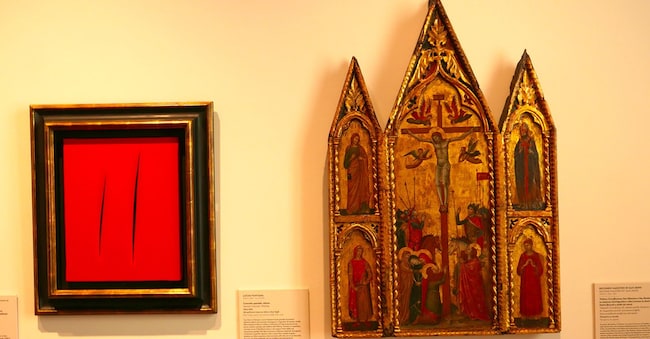
With the exhibition venue at the Scavi Scaligeri having recently reopened, Verona is experiencing a truly exciting artistic period, spearheaded by Palazzo Maffei. Luigi Carlon has shown the same foresight in choosing a home for his collection – which ranges from Mesopotamian and Egyptian art to the very latest contemporary works – as he has in the business world. The eight hundred pieces that have marked his journey as a lover of beauty – from paintings to artefacts, from sculptures to antiques – have found their home in this Baroque palace at the head of Piazza delle Erbe, the Roman Capitolium, a home for both the present and the future. In the thirty rooms spread across the two main floors – whilst the terrace, accessible via a sinuous spiral staircase, offers spectacular views over the decumanus, the River Adige, and Veronetta – a harmonious journey unfolds, ‘guided’ by Lucio Fontana, demonstrating how different styles can coexist even when they are expressions of vastly different eras. Here, then, Picasso – particularly through his sensual ceramics – embraces Boccioni, whilst Burri flirts with Venetian painting. Meanwhile, Zenone Veronese, Nicola Giolfino and Paolo Caliari – that is to say, the Veronese – strike an unexpected rapport with Vedova, Chiara Dynys and Maurizio Cattelan. Even the evanescence of Leandro Erlich’s *Nuvola* (Cloud) finds a delightful affinity with Giovanni Boldini’s elegant, voluptuous women. And Magritte kindles the fire of the imagination, amidst Modigliani’s enigmas and Hokusai’s waves. Once outside, whilst the light bathes Piazza delle Erbe in a youthful glow, one first savours a coffee at Casa Mazzanti, admiring the Renaissance frescoes in the small inner room and sampling its desserts. Then, for lunch, head to the Olivo 1939 restaurant – not just to enjoy the fish dishes whilst gazing at that Roman ‘flying saucer’ that resembles the Arena when viewed from below. But also to descend into its almost secret Futurist Room: in the basement, in fact, of the 16th-century Palazzo Fracasso-Gianfilippi, first Albino Siviero and then, shortly afterwards, Ernesto Amos Tomba performed avant-garde interpretations of the most poignant scenes from *Romeo and Juliet*, thus bestowing a gift of timeless beauty upon the venue that hosted them and often provided them with sustenance.

