
The autumn colours of Lessinia and Verona are dominated by ammonite red
The Sacred and the Profane: The Church of St Anastasia and the Arena Casarini at the Hotel Due Torri

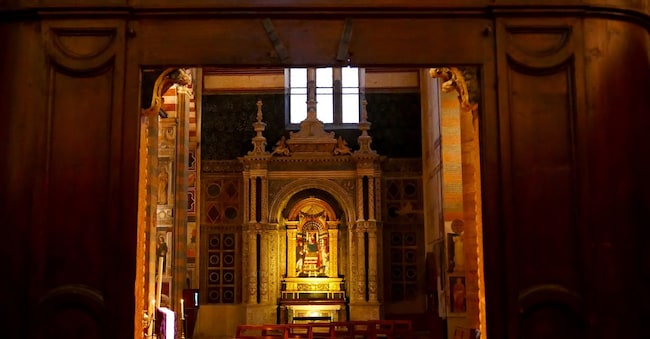
Just before sunset, the Italian Gothic façade of the Church of St Anastasia takes on a fiery red hue that softens the austerity of this world-famous church. It is Verona’s largest place of worship, with its three naves supported by no fewer than twelve columns of local red marble. As you walk across the floor, whose vivid colours evoke the friars’ habits and the blood of Christ’s Passion, you find yourself facing the painting of St George and the Princess by Pisanello on the outer cornice of the Pellegrini Chapel. You are greeted by the ‘hunchback’ sculpted by Gabriele Calliari, father of Veronese, who carries a holy water font on his shoulders. And then, one is astounded by the compositional and pictorial richness expressed by the chapels and altars, in particular by the 24 terracotta figures decorating the Pellegrini Chapel, which narrate the life of Christ, the work of Michele da Firenze. Girolamo dai Libri, too, was gifted with inspiration and talent. The cross in the presbytery chapel, on the other hand, dates back to the mid-15th century. Even in the morning, Sant’Anastasia is shrouded in timeless charm, especially when viewed from the rooms of the Hotel Due Torri, a 14th-century palace flanking the church that is the symbol of the whole of Verona. The tapestries, the 19th- and 20th-century furniture – some in the Biedermeier style – and the chandeliers were restored to their former splendour by Enrico Wallner, who, after the Second World War, took this intimate and elegant building to heart. As well as enjoying the experience of its restaurant, Bistrot al 2, within the Sala dell’Aquila – personally designed by Gualtiero Marchesi with gilded wall finishes reminiscent of his rice dishes – and the breakfast room, where frescoes dedicated to the city allow you to move about whilst savouring the rose cake, you simply must be shown to the Arena Casarini: in this hidden equestrian circus in the basement, you’ll find yourself surrounded by acrobats, jugglers, clowns, animal tamers, contortionists and dancers painted by the theatrical and visionary Pino Casarini, who depicted bears, elephants and horses, monkeys, giraffes, camels and camels – almost like Fellini’s *Notti di Cabiria* – irreverent, sardonic, playful, inviting you to play, to dream, to liberate your senses and shed your inhibitions. The sacred and the profane, in short, seem to go hand in hand here. So much so that the Due Torri was chosen by Mozart, Goethe, the poet Heine, the emperors of Austria, Wagner, the Shah of Persia, Maria Callas and Rita Levi Montalcini. Even Giuseppe Garibaldi appeared on its balcony – though to promise the cheering crowd that he would drive out the invaders.

