
Federician Apulia: a blend of history and tradition, nature and good food
At Castel del Monte and in the Alta Murgia Park

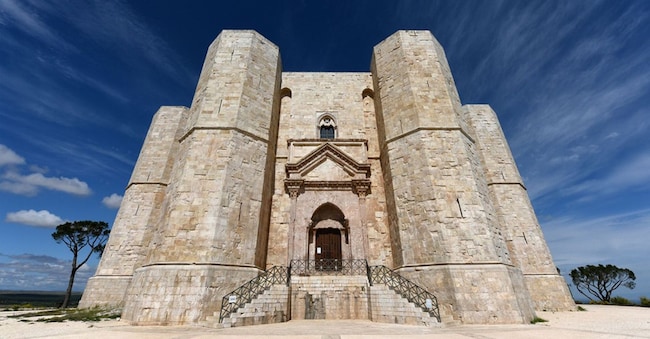
Castel del Monte, a UNESCO World Heritage Site since 1994, is, for many, the best-known legacy – and the most prestigious symbol – of Frederick II of Swabia’s presence in this region: the majestic concentric octagonal fortification, which echoes the shape of the king’s crown, is considered one of the most fascinating monuments of the European Middle Ages. Situated in the municipality of Andria, at the highest point of the area, at an altitude of 542 metres, this 13th-century fortress boasts a history shrouded in mystery and a function that clearly celebrates the power and ambition of a sovereign who is still celebrated today as the ‘Stupor Mundi’.
Alongside its historical and architectural treasures, the Alta Murgia National Park – home to one of the most important natural areas in southern Italia – offers a unique landscape characterised by karst plateaus, pastures, woods, ravines and ancient farmsteads. Olive groves, cultivated and uncultivated fields, sparse vegetation and a limestone bedrock form the backdrop to a rugged, barren, gently undulating and sparsely populated – these are the ingredients of a landscape that is almost monochrome (dark yellow at this time of year) and rather fascinating. Significant in terms of biodiversity due to the numerous plant and animal species it is home to, the Park is becoming a popular destination for its archaeological and rural heritage, which bears witness to the deep bond between man and the environment over the centuries, attracting visitors and tourists to towns such as Bitonto, renowned for its Romanesque cathedral and olive oil, Minervino Murge, the ‘balcony of Puglia’, or Toritto, a town renowned for its production of traditional almonds.

