
All the beauty of Livorno in ten summer adventures
Walking along the Acquedotto Leopoldino between neoclassical cisterns and arches
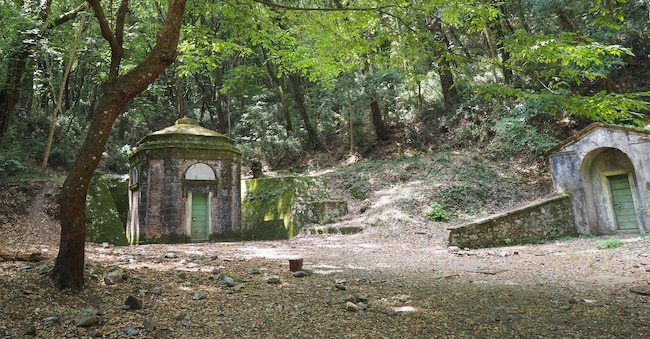
In the veins of the Monti Livornesi Park flows the water of the Leopoldine Aqueduct channelled in pipes and inside very scenic constructions. The credit for this was due to the architect Pasquale Poccianti, who thought up an itinerary to be followed on foot right from the beginning, alongside this 18-kilometre-long water system that is still partly in use today. The starting point is the medieval village of Colognole, close to the Via Emilia crossing. Organised by Visit Livorno, the forge of all initiatives for discovering the area, together with the naturalist guides of the Itinera Cooperative, accompanied in the sky by blackcaps and buzzards and immersed on the ground among ancient holm oaks, we proceed along the mule tracks, inside the valley furrowed by the Morra stream, advancing among serpentine rocks. Used from 1842 to 1912 to supply Livorno, this aqueduct crosses a landscape of great botanical purity, where ferns and butcher's broom often peep out. One walks over the stone pipeline balancing like tightrope walkers, never running the risk of falling. The spoils resemble caskets, just as the chambers of calm present graceful shapes. Past a few flights of steps, you reach the major springs, an open space between the trees that exudes great energy. The aqueduct can be found among the 42 spectacular arches near the Cisternino di Pian di Rota, a neoclassical construction with a colonnaded portico in which the water used to dwell. And then to the Cisternone characterised by a half-dome with coffered ceiling and an eight-column portico. The Cisternino di città is an equally scenic neoclassical reservoir.

